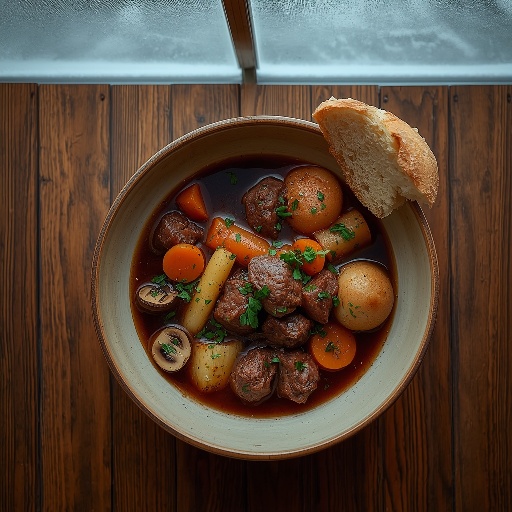
When Chicago decides it’s winter, it commits. This is the stew for those days — built for a slow cooker, designed without potatoes, and influenced by the hearty, no-nonsense cooking tradition of the Midwest. Rich broth, fall-apart beef, and root vegetables that can take the long haul.
| 20 min | 8–10 hrs | 4–5 hrs | 6 |
| Morning prep | Slow cook (low) | Slow cook (high) | Generous servings |
Why Chicago winters make slow cooker stew a necessity
Chicago winters are a different category of cold. The wind off Lake Michigan doesn’t just drop the temperature — it redefines what cold feels like when it hits an exposed face at the corner of Michigan and Wacker. When the city is locked into January or February, the idea of coming home to a pot of beef stew that’s been going since morning isn’t just appealing, it’s almost survival logic.
The slow cooker fits this rhythm perfectly. Start it before work, come home to an apartment full of the kind of smell that makes a twelve-degree commute feel worth it. There’s a deep practicality to this kind of cooking that suits Chicago’s character — direct, no-nonsense, built to do the job.
Slow cookers and the science of low heat: A slow cooker operates between roughly 79°C (175°F) on the low setting and 90°C (194°F) on high — just below the full boil point of water. According to food science literature, this temperature range is ideal for collagen-rich cuts of beef because it allows collagen to convert to gelatin slowly without driving out the moisture that a rolling boil would. The result is meat that is simultaneously fall-apart tender and juicy rather than dry. This is exactly why beef stew made in a slow cooker frequently tastes better than stovetop or oven versions.
Chicago also has a deep Midwestern food tradition worth noting. The city’s meat industry history, centred around the Union Stock Yards that operated from 1865 to 1971, made beef a central element of Chicago cooking culture. Slow-cooked beef dishes — braises, stews, and pot roasts — are thoroughly embedded in the city’s culinary identity. This stew sits squarely in that tradition.
Why skip potatoes — and what actually replaces them
Potatoes are in almost every traditional beef stew recipe. They add bulk, they absorb the broth, and they’re cheap. But they have a problem in the slow cooker context specifically: they go mushy. Potato starch breaks down after 6+ hours of low heat, and by the time your beef is properly tender, the potatoes have often dissolved into a grainy paste that thickens the stew whether you wanted it to or not.
The other reasons people skip them are personal — low-carb diets, blood sugar management, or simply preferring a cleaner, broth-forward stew rather than a thick, starchy one. All valid. The good news is that several root vegetables hold up far better than potatoes in a long slow cook while providing the same satisfying bulk.
On glycemic load and root vegetables: For people managing blood sugar — a common reason to remove potatoes — turnips, celeriac, and parsnips all have significantly lower glycemic index values than white or yellow potatoes. According to nutritional research referenced by the Harvard T.H. Chan School of Public Health, the GI of white potatoes ranges from 70–90 depending on cooking method, while turnips sit around 30 and celeriac around 35. For anyone cooking this stew with blood sugar in mind, these swaps are genuinely meaningful, not just cosmetic.
Choosing the right beef cut
Cut selection makes or breaks slow cooker beef stew. The wrong cut — something lean and tender, like sirloin or tenderloin — produces stringy, dry, flavourless results after eight hours in a slow cooker. Low, sustained heat is brutal to lean cuts. It drives out moisture faster than the tissue can absorb it back.
| Chuck roast / chuck shoulder | Beef short ribs (boneless) | Brisket |
| Best choice | Exceptional | Very good |
| Budget-friendly | Chicago favourite | |
| High in collagen and intramuscular fat. Gelatinises beautifully over 8 hours. The standard choice for a reason. Cut into 4–5cm cubes yourself for better control over size. | More expensive but produces a richer broth. Popular in Chicago’s steakhouse culture. Boneless short rib cut into cubes gives extraordinary flavour and a deeply silky braising liquid. | Point cut preferred over flat. Lots of connective tissue. Slightly firmer texture than chuck when cubed, but excellent flavour. Chicago’s Jewish deli tradition has deep brisket roots — it feels locally appropriate. |
| Stew meat (pre-cut) | Sirloin or round | Oxtail |
| Convenient | Not recommended | |
| Budget-friendly | Richest broth | |
| Pre-packaged stew meat is often a mix of cuts. Quality varies — at a good butcher it’s fine; supermarket stew meat can be inconsistent. Ask what cut it comes from if you can. | Too lean for 8 hours of slow cooking. Will be dry and stringy by the time the stew is done regardless of liquid levels. Save these cuts for quick, high-heat cooking methods. | Produces the most collagen-rich, gelatinous broth of any cut. Bones make serving more involved. Best if you want maximum broth depth and don’t mind picking meat from the bone. |
The best potato-free vegetables for beef stew
The key requirement for vegetables in a long slow cook is structural integrity — the ability to hold shape after 8+ hours of low heat without dissolving into the broth. Most delicate vegetables fail this test badly. Root vegetables are the natural answer.
| Turnips | Celeriac | Parsnips |
| Low carb | Low carb | Moderate carb |
| Holds shape | Holds shape | Naturally sweet |
| The single best potato replacement in a slow cooker stew. Holds its structure over 8 hours. Mild peppery flavour that mellows into the broth. Cut into 3–4cm chunks. | Earthy, slightly celery-like. Dense enough to survive a long cook. Underused in American cooking — one of the best root vegetables for braises and stews. | Sweeter than turnip. Adds a pleasant depth to the broth. Softens more than turnip over a long cook — add in the last 2–3 hours if you prefer them less soft. |
| Carrots | Mushrooms | Butternut squash |
| Moderate carb | Very low carb | Moderate carb |
| Standard choice | Umami | Autumnal |
| The reliable base. Cut thick (4–5cm) so they hold over the full cook. Thin carrot rounds dissolve. Large chunks stay identifiable and add natural sweetness to the broth. | Cremini or portobello. Whole cremini mushrooms added in the last 2 hours hold their shape and contribute deep umami to the broth. Added earlier, they dissolve into the sauce. | Seasonal and excellent in a Chicago autumn or early winter stew. Adds sweetness and colour. Add in the last 3 hours — it softens faster than root vegetables and can go mushy if cooked the full time. |
Full recipe
Ingredients (serves 6)
| 1.2kg chuck roast, cut into 4–5cm cubes | 3 medium turnips, peeled and cubed | 3 large carrots, cut into thick rounds |
| Cut it yourself from a whole roast if possible — pre-cut stew meat is often uneven in size, which means uneven cooking. Trim large fat caps but leave some — fat is flavour in a long braise. | The potato stand-in. Cut to roughly the same size as the beef cubes. Uneven sizes mean some dissolve while others stay firm. | At least 4cm thick. Thinner and they’ll dissolve by hour six. These should be identifiable chunks in the finished stew, not soft orange paste. |
| 2 parsnips, peeled and chunked | 200g cremini mushrooms, whole | 1 large onion, roughly chopped |
| Adds sweetness and body. If you want them firmer in the final stew, add them in the last 3 hours rather than at the start. | Add in the last 2 hours. Whole mushrooms survive the slow cook with their texture intact. Added at the start, they virtually disappear into the broth — which is fine if that’s what you want. | Will soften completely into the broth over 8 hours. If you want visible onion in the finished stew, add half at the start and half in the last 2 hours. |
| 4 garlic cloves, smashed | 2 stalks celery, roughly sliced | 480ml good beef stock |
| Whole smashed cloves mellow slowly and add depth without becoming sharp. Minced garlic can go slightly bitter over 8 hours — whole is better for long cooks. | Aromatic base. Dissolves into the broth over the full cook, contributing flavour throughout. Not a visual ingredient in the finished stew. | The single most important liquid ingredient. Low-sodium so you control salt levels. Homemade is transformative; quality store-bought bone broth is the next best option. |
| 240ml dark beer — Guinness or a Chicago craft stout | 2 tbsp tomato paste | 1 tbsp Worcestershire sauce |
| Optional but excellent. Adds malt depth and subtle bitterness that balances the richness. Revolution Brewing or Goose Island in Chicago make excellent stout options. Skip for alcohol-free version. | Brown briefly in the pan before the broth goes in. Cooked tomato paste adds depth and a mild acidity that lifts the entire broth. This step takes 90 seconds and is worth it. | A classic stew ingredient for good reason. Adds umami, a faint tang, and a background sweetness. Goes directly into the slow cooker insert with the liquid. |
| 2 tsp dried thyme, 1 tsp smoked paprika, 2 bay leaves | 2 tbsp all-purpose flour (for dredging) | 2 tbsp neutral oil for searing |
| The spice profile. Smoked paprika adds a subtle depth that works particularly well in a stew without wine. Bay leaves are slow-release flavour — remove before serving. | For coating the beef before searing. Creates the crust that holds moisture during the long cook and thickens the broth slightly as it cooks. Omit for gluten-free version and thicken with arrowroot at the end instead. | High smoke point — canola, vegetable, or avocado oil. Not olive oil; the smoking point is too low for the sear temperature you need. |
| Salt, black pepper, fresh parsley to finish | ||
| Season the beef before dredging. Season the broth at the end, not at the start — the broth reduces and concentrates, so early salt often leads to an overseasoned final result. |
Method — morning prep to evening table
- Pat the beef cubes dry with kitchen paper. Season generously with salt and pepper. Toss in the flour until each piece is lightly coated. This step takes about three minutes and is the structural foundation of the stew’s body.
- Heat oil in a large, heavy skillet over high heat. Working in batches — never crowding the pan — sear the beef cubes until deeply browned on at least two sides, about 2–3 minutes per side. This is the step most people skip. Don’t. Transfer each batch to the slow cooker insert as it’s done.
- Reduce the heat to medium. In the same pan, add the onion and celery and cook for 3–4 minutes. Add the garlic and tomato paste. Stir constantly for 90 seconds — the paste will darken slightly. This brief cooking time converts the raw tomato flavour into something deeper and more complex.
- Add the beer (or ½ cup of beef stock if skipping alcohol) to the pan and scrape the bottom vigorously with a wooden spoon. Every browned bit that comes up is concentrated flavour. Let it bubble for 30 seconds, then pour the entire contents of the pan into the slow cooker over the beef.
- Add the beef stock, Worcestershire sauce, thyme, smoked paprika, and bay leaves to the slow cooker. Add the turnips, carrots, and parsnips. Stir gently to combine everything. The liquid should nearly cover the vegetables and beef — if it doesn’t quite reach, add a splash more stock.
- Cover and set to low for 8–10 hours, or high for 4–5 hours. The low setting is better — the longer, slower cook produces a more complex flavour and a more tender result. Leave it. Opening the lid repeatedly releases heat and adds 20–30 minutes to the cook time each time.
- With 2 hours remaining, add the whole cremini mushrooms. Replace the lid quickly. They’ll soften perfectly by the time the stew is done without the disintegration that happens when mushrooms go in at the start.
- When the stew is done, remove the bay leaves. Taste the broth and season carefully with salt. If the broth is thinner than you’d like, mix 1 tablespoon of arrowroot or cornstarch with 2 tablespoons of cold water, stir into the stew, replace the lid, and cook on high for 15 minutes until thickened.
- Scatter fresh flat-leaf parsley over the top before serving. The fresh herb at the end brightens a stew that’s been cooking for eight hours in ways that dried herbs added at the start simply cannot replicate. Rest for 5 minutes, then serve.
Building the broth — rich, dark, deeply flavoured
The broth is not an afterthought. In a potato-free stew, the broth is even more prominent because there’s no starchy vegetable absorbing and muting it. Every ingredient you put in the liquid becomes part of what you’re tasting in every spoonful.
The dark beer choice
Guinness is the most accessible option and works reliably. In Chicago, the local craft beer scene offers excellent alternatives — Revolution Brewing’s Anti-Hero IPA is too bitter and hoppy, but their Straight Jacket barleywine or Goose Island’s Bourbon County Stout (in smaller amounts) both add malt sweetness and complexity without overwhelming. A dry Irish stout or an English brown ale are broadly the right style: malty, not too bitter, not too sweet.
Without beer — the alcohol-free version
Replace the beer with an additional 240ml of beef stock plus 1 tablespoon of apple cider vinegar and 1 teaspoon of molasses. The vinegar provides acidity; the molasses adds the dark, malty depth that stout contributes. It’s a surprisingly effective substitute and produces a stew that doesn’t taste like it’s missing anything.
The tomato paste step — don’t skip it
Two tablespoons of tomato paste cooked briefly in a hot pan before the liquid goes in adds a level of depth that raw tomato paste stirred directly into the slow cooker doesn’t achieve. The brief browning develops umami compounds through the Maillard reaction. It takes ninety seconds. It’s genuinely worth the extra pan.
Browning the meat — the step most slow cooker recipes skip
A lot of slow cooker recipes will tell you to just dump everything in raw. You can do that. The stew will be edible. But it won’t have the same depth, the broth won’t be as dark, and the meat won’t have that particular flavour that comes from the Maillard reaction — the chemical browning of protein at high, dry heat.
The Maillard reaction in slow cooker context: The Maillard reaction requires temperatures above 140°C (280°F) to occur — well above the maximum temperature of a slow cooker. According to food science sources, this reaction creates hundreds of distinct flavour compounds that are responsible for the complex, roasted, “meaty” flavour associated with browned meat. A slow cooker never reaches this temperature, which means any Maillard compounds in your stew must be created externally, before the ingredients go into the appliance. This is the scientific basis for searing before slow cooking — it’s not optional if you want maximum flavour. [Reference 3 — Wikipedia: Maillard reaction — see authority links]
The practical reality: searing takes about twelve minutes. Set up the pan while the slow cooker preheats, work in three batches, and you’re done before the coffee is finished. The stew you get in return is categorically richer and more complex.
What to serve it with
| Thick-cut sourdough | Egg noodles | Creamy polenta |
| The obvious and correct choice. The broth is the star and you want something to soak it up. A good Chicago bakery sourdough — or any dense, crusty loaf — is the best vehicle. | Classic midwestern pairing. Wide egg noodles tossed in a little butter and served in the bowl before the stew is ladled over. Adds the bulk that potatoes would have provided without the glycemic hit. | Soft polenta made with chicken or vegetable stock, finished with butter and parmesan. The stew poured over polenta is one of the more satisfying things a slow cooker can produce. |
| Cauliflower mash | Steamed barley | Nothing at all |
| For a fully potato-free, lower carb meal. Roasted cauliflower blended with butter and stock makes a surprisingly rich mash that pairs well with the stew’s deep broth. | Add directly to the slow cooker in the last 2 hours and it cooks in the broth, thickening it naturally. Nutty, hearty, and deeply appropriate for a Chicago winter table. | On the coldest nights — the kind Chicago specialises in — a bowl of this stew alone, with bread for the broth, is exactly enough. No side dish needed. |
Make-ahead, storage, and reheating
Beef stew is one of the dishes that genuinely improves after a night in the fridge. The fat solidifies on the surface and can be lifted off cleanly. The flavours consolidate. The collagen firms the broth to a loose jelly. Day two is better than day one — which is a useful thing to know if you’re cooking for a specific occasion.
| Refrigerator storage | Freezing | Thawing |
| Airtight container, up to 5 days. Cool completely before covering — hot stew in a sealed container creates condensation that dilutes the broth. | Freezes very well for up to 3 months. The root vegetables (turnips especially) hold their texture after freezing better than potatoes would. Portion into individual servings before freezing. | Overnight in the fridge. Don’t thaw on the counter — the outer layers reach room temperature while the centre is still frozen, which is a food safety concern with meat-based dishes. |
| Reheating | Day-before prep | Chicago weather tip |
| Gently on the stovetop over medium-low heat with a splash of stock to loosen. The broth tightens overnight as the gelatin sets — it thins back to the right consistency with a little heat and liquid. | Brown the beef and refrigerate overnight, then add everything to the slow cooker in the morning. Saves time on the morning itself and the seared beef picks up even more flavour during the overnight rest. | On particularly brutal days, a slow cooker timer means the stew is ready when you walk in the door — no standing at the stove after a wind-chilled commute. Set it up, leave it, come home to dinner. |
Common slow cooker mistakes
Too much liquid
A slow cooker doesn’t evaporate liquid the way an open pot does. The lid traps steam, which condenses and drips back. If you start with too much liquid, you end up with a watery stew rather than a rich broth. The liquid should barely cover the ingredients, not flood the pot. Less is almost always right with slow cooker stews.
Lifting the lid repeatedly
Each time the lid comes off, the temperature inside drops by roughly 10–15°C and takes 20–30 minutes to recover. Over an 8-hour cook, three or four unnecessary lid lifts can add over an hour to the cooking time. Check at the 7-hour mark, add the mushrooms at hour 6, and otherwise leave it alone.
Using the high setting for the full time
The high setting is a shortcut, not an equivalent. Low and slow produces a more tender, more flavourful result because the gradual temperature rise allows the collagen conversion to happen more completely. If you can plan eight hours ahead, always use low. High is for when you genuinely can’t.
Seasoning heavily at the start
The broth concentrates as it cooks, even in a slow cooker. Salt added at the beginning at the right level becomes over-salted by the end. Add a conservative amount of seasoning at the start — enough to season the beef before searing — and adjust the final broth carefully at the end, when you know what you’re working with.
Adding delicate vegetables at the start
Peas, green beans, zucchini, spinach — anything that cooks quickly at normal temperatures will be unrecognisable mush after 8 hours. These belong in the last 20–30 minutes at most. The root vegetables in this recipe are specifically chosen because they can handle the full cook. Stick to them, or add anything delicate very late.
See Also –
See Also –