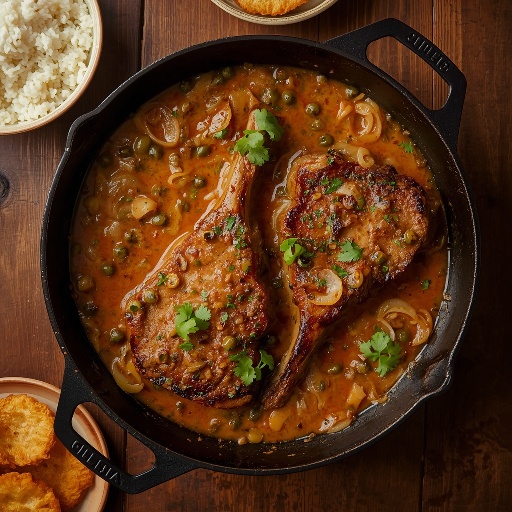
Two comfort food traditions — the Southern American technique of smothering pork chops in a thick, savoury onion gravy, and the Puerto Rican foundation of sofrito, sazón, and adobo — come together in one dish that’s richer and more complex than either tradition alone. This guide covers both, the full recipe, and how the fusion actually works.
| 15 min | 35–40 min | 4 | 1 |
| Prep time | Cook time | Servings | Pan, start to finish |
Where These Two Traditions Meet
Smothered pork chops are a fixture of Southern American soul food — braised in a rich onion and flour-thickened gravy until tender, served over rice or with biscuits, deeply satisfying in the way that long-cooked comfort food always is. Puerto Rican home cooking has its own deeply developed pork tradition: pernil, chuletas, fricase de cerdo — pork prepared with sofrito, sazón, adobo, and the characteristic blend of aromatics that defines the island’s flavour profile.
These two traditions share more than they differ. Both are built around braising or slow-cooking tough cuts of pork into tenderness. Both rely on aromatic vegetables as the flavour base. Both produce a rich, thick sauce that’s as important as the meat itself. The fusion in this recipe isn’t forced — it’s a recognition that the two cooking philosophies are doing the same thing with different spice vocabularies.
The history of Puerto Rican culinary identity: Puerto Rican cuisine is a synthesis of three distinct culinary traditions — Indigenous Taíno, Spanish colonial, and West African — that merged over centuries of island history. According to Wikipedia’s entry on Puerto Rican cuisine, the Taíno contributed root vegetables and cooking methods; Spanish colonists brought pork, rice, garlic, and olive oil; and African enslaved people introduced plantains, pigeon peas, and deep-frying techniques. Pork has been central to Puerto Rican cooking since Spanish colonial introduction and remains the island’s most culturally significant protein — making it the natural bridge between the Southern smothered tradition and the Puerto Rican kitchen.
What Southern Smothered Pork Chops Actually Are
The word “smothered” in Southern cooking specifically refers to the technique of braising meat in a pan gravy — usually a dark, onion-rich sauce built from the drippings left after searing. The meat is dredged in seasoned flour, seared until deeply browned, then covered (smothered) in the gravy and cooked low and slow until tender.
The flour dredge does several things at once. It creates a crust on the pork that holds moisture during the braise. It thickens the pan sauce as it cooks. And it contributes to the deep colour and body of the finished gravy in a way that an un-dredged chop never could.
On Southern soul food and its roots: Soul food as a culinary category developed from the cooking traditions of African Americans in the Southern United States, drawing heavily on West African food culture adapted through the conditions of slavery and the post-Civil War era. According to Wikipedia’s entry on soul food, smothered meats — pork chops, chicken, and oxtail braised in thick pan gravies — are among the technique’s most enduring expressions, reflecting both the ingenuity of cooking cheaper, tougher cuts to tenderness and the deep culinary knowledge brought from West African cooking traditions. The overlap with Caribbean braising traditions is not coincidental — both share West African roots.
The Puerto Rican Seasoning Foundation
Understanding what Puerto Rican seasoning brings to this dish requires knowing the three layers that define the island’s cooking. Each one plays a different role, and each one carries into the finished gravy.
| Sofrito | Sazón | Adobo |
| Flavour base | Colour + depth | All-purpose seasoning |
| A blended paste of ají dulce peppers, culantro, cilantro, garlic, onion, and tomatoes. It’s cooked in oil at the beginning of almost every Puerto Rican dish to build the aromatic base. In this recipe, it replaces or supplements the onion that forms the gravy’s foundation. | A pre-made spice blend of achiote (annatto), coriander, cumin, garlic powder, and oregano. The annatto gives dishes their characteristic orange-golden colour. One packet goes directly into the gravy — it transforms the colour and adds complexity that salt and pepper alone can’t achieve. | A dry blend of garlic powder, oregano, black pepper, salt, and turmeric. Used to season the pork chops before dredging — replaces the simpler salt and pepper seasoning of a traditional Southern smother with something more complex. |
| Recao (culantro) | Olives and capers | Ají dulce peppers |
| Fresh herb | Brine and umami | Sweet pepper |
| A stronger, more pungent relative of cilantro used throughout Puerto Rican cooking. If you can find it fresh (Latin grocery stores usually carry it), add a few leaves to the gravy while it simmers. If not, fresh cilantro is a reasonable substitute. | Manzanilla olives and alcaparras (small capers) appear in many Puerto Rican braised pork dishes. Added to the gravy, they provide a briny, savoury contrast that cuts through the richness of the pork and flour-thickened sauce. | Small, sweet peppers essential to authentic sofrito. They look like scotch bonnets but contain almost no heat. Available at Latin grocery stores. If unavailable, mini sweet peppers are the best substitute. |
How the Two Approaches Combine
| Traditional Southern | Puerto Rican approach | This recipe |
| Soul food method | Island method | Best of both |
| Pork chops seasoned with salt and pepper, dredged in flour, seared in vegetable oil or lard, then smothered in a gravy built from sliced onions, the pan drippings, chicken stock, and a flour roux. Rich, dark, deeply savoury. | Pork chops rubbed with adobo and marinated (or seasoned just before cooking). Seared in olive oil, then braised in a sauce built from sofrito, sazón, tomato sauce, and stock. The colour is golden-orange; the flavour has herbs, cumin, annatto. | Pork chops rubbed with adobo, dredged in seasoned flour (Southern technique), seared deeply, then smothered in a gravy built from sofrito, sazón, sliced onion, and chicken stock — plus olives and capers for the Puerto Rican brine note. |
Full Recipe
Ingredients
| 4 bone-in pork chops, ¾–1 inch thick | 2 tsp adobo seasoning | ¾ cup all-purpose flour |
| Bone-in stays juicier through the braise. See the cut selection section below for more detail. Pat completely dry before seasoning. | Goya adobo is the standard Puerto Rican pantry version. Or make it: garlic powder, dried oregano, salt, black pepper, turmeric in roughly equal parts. Rub all over the chops. | For dredging. Season the flour itself with a pinch of adobo, garlic powder, and black pepper — the dredge carries seasoning directly into the crust. |
| 3 tbsp olive oil or neutral oil | 3 tbsp sofrito (homemade or Goya jarred) | 1 packet sazón con achiote |
| Olive oil is more Puerto Rican in character. Neutral oil (canola, avocado) gives a cleaner sear at higher heat. Either works — use olive oil for flavour, neutral for a hotter sear. | The flavour cornerstone. Jarred Goya sofrito works well and is available at most grocery stores. Homemade is better — blend ají dulce, garlic, onion, culantro, cilantro, and tomato. | The golden-orange colour of this dish’s gravy comes entirely from the achiote (annatto) in sazón. Use one full packet — don’t halve it. |
| 1 large onion, thinly sliced | 4 garlic cloves, minced | ½ cup tomato sauce |
| The Southern element — onions cook down into the gravy and provide the body and sweetness that balances the sazón’s earthiness. Slice thin so they soften completely. | Added with the sofrito. Both traditions — Southern and Puerto Rican — depend heavily on garlic. Don’t reduce this. | Adds acidity and body to the gravy. Puerto Rican cooking uses tomato sauce more than crushed or diced tomatoes — the smoother consistency integrates better into a finished gravy. |
| ¼ cup manzanilla olives, halved | 1 tbsp capers (alcaparras), rinsed | 1½ cups chicken stock or broth |
| The Puerto Rican brine note. Green olives add a savoury, slightly salty contrast that a traditional Southern smother doesn’t have. They soften into the gravy and become mild — don’t skip them. | Paired with the olives. Rinse before adding to manage saltiness. Small capers available at Latin grocery stores are more traditional — regular capers work. | The braising liquid. Low-sodium preferred — the adobo and sazón both contain salt, and a full-sodium broth can make the gravy too salty by the time it reduces. |
| Fresh cilantro to finish | 1 tsp dried oregano (preferably Mexican or Caribbean variety) | |
| A handful of fresh cilantro stirred in at the end lifts the entire dish. The gravy has been building rich, deep flavours — the fresh herb at the end provides necessary brightness. | Caribbean oregano has a slightly different, more citrusy character than Mediterranean. Available at Latin grocery stores. Standard dried oregano works as a substitute. |
Method — one skillet, start to finish
- Pat the pork chops completely dry with paper towel. Season both sides generously with adobo — more than you think you need. Let them sit for 10 minutes while you prepare everything else. If you have time the night before, season and refrigerate uncovered overnight. The dry rub forms a light crust on the surface that sears better than unseasoned meat.
- Mix the flour with a pinch of adobo, garlic powder, and black pepper in a shallow plate. Dredge each pork chop in the seasoned flour, pressing firmly so the flour adheres to all surfaces. Shake off the excess — a thin, even coat is what you want, not a thick crust.
- Heat oil in a large, heavy-bottomed skillet — cast iron is ideal — over medium-high heat until shimmering. Add the pork chops and sear without moving for 3–4 minutes until deeply golden on the first side. Flip and sear the second side for 2–3 minutes. The chops won’t be cooked through — that happens during the braise. Remove and set aside. The dark fond left in the pan is what the gravy is built on.
- Reduce heat to medium. Add the sliced onions to the pan. Cook in the oil and pork drippings for 6–8 minutes, stirring occasionally, until they soften and begin to turn golden at the edges. They’re absorbing all the flavour from the seared pork — don’t rush this step.
- Add the sofrito and minced garlic. Stir constantly for 2 minutes. The sofrito sizzles and releases its aromatics into the fat — you’ll smell the shift from raw to cooked almost immediately. Add the sazón packet and dried oregano. Stir for one more minute.
- Add the tomato sauce and stir to combine. Let it cook for 2 minutes until it darkens slightly and loses its raw edge. Pour in the chicken stock. Scrape the bottom of the pan with a wooden spoon — every bit of browned flour and fond from the sear goes into the gravy here. Add the olives and capers.
- Bring the gravy to a simmer and taste. Season with salt if needed — remember the sazón and olives carry salt, so be careful here. The gravy should taste deeply savoury and slightly complex — you should be able to identify the sofrito, the annatto, and the onion sweetness as distinct notes.
- Nestle the seared pork chops back into the skillet, submerging them partway in the gravy. Spoon gravy over the tops. Cover with a tight-fitting lid, reduce heat to medium-low, and cook for 20–25 minutes until the pork chops are completely tender and cooked through. Check occasionally — the gravy should be gently simmering, not boiling.
- Remove the lid for the final 5 minutes and let the gravy reduce slightly. It should be thick enough to coat the back of a spoon. Stir in the fresh cilantro. Taste one final time — this is your last chance to adjust salt, add a pinch more oregano, or brighten with a small squeeze of lime juice if the gravy feels too rich.
- Serve immediately. Spoon the gravy generously over the chops and whatever starch is beneath them. The gravy is the dish as much as the pork is — don’t be conservative with it.
Building the Puerto Rican–Style Gravy
The gravy in this recipe is where the fusion is most visible. A traditional Southern smother produces a pale to medium-brown gravy — the colour comes from the roux and the caramelised onions. This Puerto Rican version is deep golden-orange from the achiote in the sazón, with a more complex aromatic base from the sofrito.
Consistency — how thick it should be
The flour from the dredge thickens the gravy as it cooks. The target is thick enough to coat a spoon but pourable — not a paste. If it gets too thick during the braise, add a splash of chicken stock. If it’s too thin after removing the lid, simmer uncovered for an additional 5 minutes.
The achiote colour
Achiote (annatto) in the sazón is what gives this dish its orange-gold colour. It’s a natural colourant and flavour contributor — mild, slightly earthy, not spicy at all. If the gravy looks pale, it usually means the sazón hasn’t had enough time to cook into the sauce. Give it another 2–3 minutes of open simmering.
Sofrito quantity
Three tablespoons is the starting point. If you like a more pronounced Puerto Rican flavour profile, use four. The sofrito’s fresh herb and garlic character amplifies significantly in a braised dish — a little more goes a long way. Add it in the step described rather than at the end; it needs to cook fully to develop rather than taste raw and grassy.
Making sofrito from scratch: Homemade sofrito is meaningfully better than jarred — the fresh herb and pepper flavour is more vivid and the texture is smoother. A basic recipe: blend together 6 ají dulce peppers (or mini sweet peppers), 1 medium onion quartered, 1 head of garlic, 1 bunch culantro or cilantro, and 2 plum tomatoes. Blend until smooth, adding a tablespoon of water if needed. Store refrigerated for up to two weeks or frozen in ice cube trays for months. According to Wikipedia’s entry on sofrito, the preparation varies by country and family tradition, but the Puerto Rican version with culantro and ají dulce is one of the most herbal and aromatic of the regional variations. [Reference 3 — Wikipedia: Sofrito — applied inline]
Choosing the Right Pork Chop Cut
Bone-in rib chops — the best choice
Cut from the rib section, these have the most fat and marbling of any pork chop cut. The bone contributes to the flavour of the braising liquid as it cooks. In a smothered preparation, where the chop is sitting in liquid for 20+ minutes, this fat content is what keeps the meat from drying out. Aim for ¾ to 1 inch thickness — thin chops overcook before the gravy develops.
Bone-in shoulder chops — a Puerto Rican preference
Shoulder chops (also called blade chops) are cut from the shoulder and have more connective tissue and fat than rib chops. They’re tougher raw but become more tender than rib chops after a long braise. Common in Puerto Rican chuleta recipes. They look less uniform than rib chops but produce a more complex, deeper flavour in the finished dish.
Boneless chops — acceptable but with caveats
Boneless pork chops work in this recipe but dry out faster and produce a less flavourful gravy. If that’s what you have, reduce the braising time to 15 minutes and check frequently. They also tend to be thinner, which means they need less total sear time on each side.
What to Serve Alongside
| White rice | Tostones | Southern-style mashed potatoes |
| The universal answer in Puerto Rican cooking and the correct one here. The gravy pools in the rice and every spoonful picks up the sazón and sofrito flavour. Arroz con gandules — rice with pigeon peas — is the more traditionally Puerto Rican pairing. | Twice-fried green plantains. The starchy, savoury crunch of tostones against the rich, saucy pork chop is one of the best textural contrasts in Puerto Rican food. Make them while the pork chops braise — the timing works out. | Keeping the Southern side of the dish — butter-heavy mashed potatoes with the Puerto Rican–style gravy poured over is a combination that works across both traditions. The gravy’s complexity is at its most obvious over something neutral. |
| Black beans | Sweet plantains (maduros) | Yuca con mojo |
| Habichuelas negras — Cuban-style black beans or Puerto Rican-style kidney beans both work. A bowl of beans on the side gives you something to ladle gravy over independently of the rice, which is useful for serving a group. | Riper, sweeter plantains fried until caramelised. The sweetness plays against the savoury pork and olives in a way that tostones (salty and starchy) doesn’t — it provides an actual flavour contrast rather than just textural variety. | Boiled yuca (cassava) dressed with a garlic and olive oil mojo sauce. Starchy enough to carry the gravy, earthy enough to stand up to it. A distinctly Puerto Rican starch option that connects this dish clearly to its island influence. |
Variations and Adjustments
Adding potatoes to the braise
Dice 2 medium potatoes into large chunks and add them to the gravy alongside the pork chops when you return them to the pan. They absorb the sazón and sofrito flavour completely and make the dish a one-pan complete meal without any separate side. A common Puerto Rican home cooking approach for making the dish stretch further.
Making it spicier
The adobo, sofrito, and sazón combination is flavourful but not particularly hot. For heat: add a chopped scotch bonnet or habanero with the sofrito, or stir in a teaspoon of hot sauce (Crystal or Tabasco work; Puerto Rican-made Maví hot sauce if you can find it) with the tomato sauce. Taste as you go — the heat concentrates as the gravy reduces.
Slow cooker adaptation
Sear the pork chops and build the gravy in a skillet as described, then transfer everything to a slow cooker and cook on low for 4–5 hours. The result is even more tender than the stovetop version — the collagen in the shoulder chops has more time to convert. Thicken the gravy at the end by simmering uncovered in a pan for 5 minutes after removing the chops.
Common Mistakes
Under-seasoning the pork
Adobo needs to go on generously. With a bone-in chop that’s a centimetre thick, the seasoning needs to be assertive enough to flavour the meat through the braise — a light dusting disappears into the gravy. Season more than feels comfortable, then taste the finished gravy and adjust salt at the end.
Skipping the sear
The sear creates the fond — the browned bits stuck to the pan — that becomes the gravy’s backbone. A skipped sear means a paler, less complex gravy that tastes cooked rather than developed. The flour dredge also browns during searing, adding a nutty dimension that’s absent if you skip straight to the braise.
Boiling instead of simmering during the braise
High heat during the covered braise causes the pork to tighten and toughen. Medium-low — a gentle, occasional bubble — is what you want. The chops should be surrounded by warmth, not agitated by rolling boil. If the gravy is boiling actively, reduce the heat immediately and add a splash of stock.
Not cooking the sofrito long enough
Raw sofrito has a sharp, grassy taste that’s unpleasant in a finished dish. It needs to cook in the oil for a full 2 minutes — until the raw herb smell shifts to something deeper and sweeter. If you add stock before the sofrito has cooked through, you’re essentially locking in that raw taste. The 2-minute cook time in step 5 is not negotiable.
See Also – Griddle breakfast recipes for camping in Michigan
See Also – Pressure cooker pulled pork from frozen — Arizona style