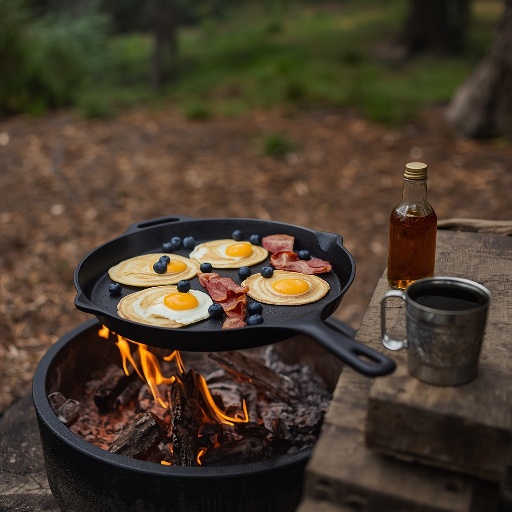
Michigan has over 100 state parks, 12,000 miles of shoreline, and a camping culture that runs from Memorial Day through the last warm weekend of October. This guide covers eight griddle breakfast recipes designed for Michigan campsites — from Sleeping Bear Dunes to the Upper Peninsula — with real campfire technique and local ingredients worth knowing about.
| 8 | 15–25 | 1 | 100+ |
| Complete recipes | Minutes per breakfast | Griddle, everything | Michigan state parks |
Michigan Camping and Why the Griddle Earns Its Spot
Michigan’s camping landscape is genuinely exceptional. The Lower Peninsula has dune parks along Lake Michigan, pine-forest campgrounds in the Manistee National Forest, and lakefront sites that fill up in May and stay full until September. The Upper Peninsula — the U.P. — is a different thing entirely: remote, often cold even in August, with sites that can feel genuinely isolated from everything.
A flat griddle over a camp stove or fire grate handles more breakfast tasks than any other single piece of camping cookware. Pancakes, eggs, bacon, hash browns, French toast, breakfast sandwiches — all of it fits on a flat surface with consistent heat. A camping griddle doesn’t require the finesse of a skillet for eggs or the timing of a grate for anything delicate. You put it down, you cook on it, you wipe it clean.
Michigan’s state park and campground system: Michigan’s Department of Natural Resources manages one of the largest state park systems in the country. According to the Michigan DNR’s state parks resource page, the state has over 100 state parks and recreation areas offering more than 14,000 campsites — from modern electric sites to rustic backcountry spots in the Upper Peninsula. This scale means Michigan campers have wildly different setups: some with full electric hookups and camp kitchens, others with just a fire ring and whatever they carried in. The griddle recipes in this article work across all of these scenarios, scaling from a propane camp stove to a fire ring with a grate.
The Michigan camping season also matters for breakfast planning. An early June morning at Pictured Rocks might be 45°F at 7am. A late August morning at Silver Lake is 70°F with humidity. What you want to eat for breakfast — and how long you want to spend making it — shifts accordingly. These recipes cover both ends of that range.
Michigan Campsite Food Worth Knowing About
Michigan has specific local foods that travel well and appear at campsite grocery stops throughout the state. Knowing what to look for makes camping breakfasts more interesting and distinctly Michigan rather than generic.
| Smoked whitefish | Michigan cherries | Pasties |
| Michigan Lakes | Northern LP | Upper Peninsula |
| Lake Superior and Lake Michigan whitefish, smoked and sold at roadside fish shacks from Traverse City north. Lasts 3–5 days unrefrigerated if vacuum-sealed. Exceptional on griddle breakfast flatbreads or stirred into scrambled eggs. | Traverse City is the cherry capital of the world. Dried Montmorency cherries from roadside stands add tartness to pancake batter or griddle-caramelised as a topping. Peak season is July. | The U.P.’s most iconic food — a Cornish meat pastry brought by copper miners. Pre-made pasties from bakeries in Marquette or Ironwood reheat beautifully on a griddle. Not a breakfast food technically, but eaten at every meal in the U.P. |
| Maple syrup | Local eggs and bacon | Blueberries |
| Statewide | Farm stands | Southwest LP |
| Michigan produces genuine maple syrup — less famous than Vermont’s but genuinely good. Sold at farm stands throughout the state. Brings pancakes and French toast to a different level than bottled corn syrup. | Michigan has numerous small farms selling eggs and pork products at farm stands along US-31, M-22, and other scenic routes. Worth stopping for if you pass one — the difference from grocery store eggs in a cast iron on a campfire is noticeable. | Southwest Michigan is the largest blueberry-growing region in the U.S. Fresh blueberries folded into griddle pancake batter in July and August are one of the specific pleasures of a Michigan camping trip. |
Michigan blueberry production: According to the USDA National Agricultural Statistics Service Michigan office, Michigan consistently leads the nation in blueberry production, harvesting over 100 million pounds in peak years. Southwest Michigan counties — Van Buren, Allegan, and Berrien — produce the majority of the crop, making fresh blueberries available at farm stands and grocery stores throughout the region from late June through August. For campers in the southwest Lower Peninsula during summer, blueberries are essentially the unofficial camp breakfast ingredient.
Griddle Setup Over a Campfire — The Honest Guide
A flat griddle on a campfire is not the same as a flat griddle on a gas stove. The heat is less predictable, the surface temperature varies across the griddle, and wind can affect the flame in ways that shift the whole cooking dynamic. None of this is unmanageable — you just need to understand it going in.
| Wait for coals, not flames | Preheat properly | Use the whole surface |
| Open flame produces dramatic, uneven heat. Gray-edged coals produce steady, predictable radiant heat. Build your fire 30–45 minutes before breakfast and wait. A bed of established coals is better than a roaring fire for griddle cooking. | Place the griddle over the coals and wait 5 full minutes before adding oil or food. Touch a drop of water to the surface — it should skitter and evaporate immediately. If it sits and simmers, wait longer. | Camp griddles develop hot spots near the center of the heat source. Rotate food from the hot center to the cooler edges. Learn your griddle’s heat map in the first 2 minutes of use. |
| Camp stove advantage | Oil before every batch | Wind management |
| A two-burner propane camp stove is more controllable than a fire for griddle cooking. If you have one, use it for griddle work and save the fire for atmosphere, coffee, and anything that benefits from smoke. | A camp griddle surface dries faster than a kitchen griddle because the heat is less controlled and the environment is drier. Add a small amount of oil or butter before each new batch of food, every time. | Wind cools the griddle surface and blows heat away unevenly. Position the griddle so the windward side is facing away from prevailing wind, or set up a simple windscreen using your cooler or a tarp if conditions require it. |
Recipes 1–3: Quick Morning Starts
01 – Michigan blueberry griddle pancakes
20 min, Camp stove or fire, Serves 4S, Summer peak
When you’re at a campsite in southwest Michigan in July, there’s essentially no excuse not to make blueberry pancakes. You can buy a pint at the farm stand ten minutes from most campsites in that region and the batter takes five minutes to mix. The griddle does everything else.
Ingredients — mix dry at home, wet at camp
- 2 cups all-purpose flour (pre-measured and packed in a zip bag at home)
- 2 tsp baking powder, 1 tsp baking soda, ½ tsp salt, 2 tbsp sugar — add to the flour bag at home
- 2 cups buttermilk (or 2 cups milk + 2 tbsp vinegar, mixed at camp)
- 2 eggs, 3 tbsp melted butter or neutral oil
- 1 cup fresh Michigan blueberries
- Michigan maple syrup for serving
Method
- Preheat the griddle over medium camp stove heat or established coals. Mix the pre-packed dry ingredients with eggs, buttermilk, and melted butter in a camp bowl until just combined — lumps are fine, overmixing makes tough pancakes.
- Add a small pat of butter to the griddle and let it foam. Pour ¼-cup portions of batter onto the surface. Immediately press 5–6 blueberries into each pancake — don’t mix them into the batter or they smear on the griddle surface.
- Cook until bubbles form and edges look set — about 3 minutes on a camp heat source. Flip once and cook 2 more minutes. Serve with Michigan maple syrup. Keep finished pancakes warm on the edge of the griddle away from direct heat.
02 – Camp griddle bacon and eggs
15 min, Camp stove or fire, Per person, Classic
Bacon and eggs on a flat griddle at a campsite is one of those experiences that’s better than the same breakfast at home in ways that are difficult to explain. The open air, the smell of the fire, the sound of the griddle — none of this is technique. But the technique does matter, and the griddle handles both at once more easily than any skillet.
- 3–4 strips thick-cut bacon per person
- 2 large eggs per person
- Salt, black pepper
- Optional: shredded cheddar, sliced campfire bread for serving
- Lay bacon strips on a cold griddle, then apply heat. Starting cold renders the fat gradually — the bacon cooks more evenly than if you lay it on a preheated surface. Cook until crispy to your preference, flipping once. Remove and rest on paper towel.
- Leave a thin layer of bacon fat on the griddle surface. Crack eggs directly onto the fat. Season immediately with salt and pepper. For fried eggs: cook until whites are fully set (3–4 minutes). For scrambled: break and stir constantly over lower heat.
- Add cheese in the final 60 seconds if using. Serve directly from the griddle — no transfer needed. The griddle keeps everything warm while you pour coffee.
03 – French toast on the griddle
15 min, Camp stove ideal, Serves 3–4, Kid favourite
Thick sandwich bread soaked in egg, milk, and cinnamon and cooked on a buttered camp griddle. The same French toast you make at home, with a slightly more caramelised exterior from the variable heat of camp cooking — which is actually an improvement. Michigan maple syrup finishes it properly.
- 6–8 thick slices bread (Texas toast thickness ideal; day-old bread is better)
- 3 eggs, ½ cup milk or powdered milk mixed at camp
- 1 tsp cinnamon, 1 tsp vanilla extract, pinch of salt
- Butter for the griddle
- Michigan maple syrup and fresh fruit to serve
- Whisk eggs, milk, cinnamon, vanilla, and salt in a shallow camp bowl or small container. Dip each bread slice for 20–30 seconds per side — don’t rush this. Soggy-to-the-center bread makes the best French toast.
- Butter the preheated griddle generously. Cook dipped bread 3–4 minutes per side until deep golden brown. Camp fire heat may caramelise faster than expected — watch the colour.
- Serve immediately with maple syrup and whatever fruit is in the cooler. Dried cherries scattered over the top are a specifically Michigan touch that works well here.
Recipes 4–6: Heartier Camp Breakfasts
04 – Camp hash browns — griddle style
25 min, Fire coals or stove, Serves 4
The moisture-removal step is especially important at a campsite because you don’t have paper towels in unlimited supply and time and heat are less controllable. The workaround: pre-squeeze at home before the trip, pack the wrung-out potato in a sealed bag, and they’re ready to go straight onto the griddle at camp.
- 3 large Russet potatoes, grated and squeezed dry (at home) — or frozen shredded hash browns from the cooler
- 1 small onion, grated (optional — adds flavour, adds prep)
- Salt, garlic powder, black pepper
- 2 tbsp neutral oil or butter
- Heat oil on the griddle over medium-high camp heat until shimmering. Spread potato in a thin, even layer — press firmly. Don’t move it for 5–6 minutes. The crust forms only with sustained contact on a hot surface.
- Season generously. Flip in sections using a wide spatula — the whole layer rarely flips as one piece at a campsite, and that’s fine. Cook the second side for 4–5 minutes until golden.
- Serve alongside eggs or topped with them. The hash browns hold heat well and can stay on the cooler edge of the griddle while eggs finish.
05 – Breakfast sausage patties and biscuits
20 min, Camp stove or fire, Serves 4
Pre-made sausage patties — either frozen or from the camp cooler — cook in under 8 minutes on a hot griddle. Pair with biscuits from a can or pre-baked from home, heated flat on the griddle surface. A complete, protein-forward breakfast that requires almost no camp prep beyond heat management.
- 8 pork breakfast sausage patties (pre-formed from home or store-bought frozen)
- 4–8 biscuits — canned refrigerator biscuits or pre-baked from home
- 4 eggs (optional, for sandwich assembly)
- Sliced American or cheddar cheese
- Place sausage patties on the cold griddle and apply heat — same approach as bacon. Cook 3–4 minutes per side until cooked through (no pink visible). Internal temperature should reach 160°F — a small instant-read thermometer is worth bringing camping if you’re cooking sausage regularly.
- While the second side cooks, place biscuit halves cut-side down on the griddle edge to warm and lightly toast.
- If making sandwiches: push sausage to the edge, add a small amount of butter to the cleared area, fry eggs. Build sandwich with biscuit, sausage, egg, and cheese. Wrap in foil for two minutes — the retained heat melts the cheese without returning it to the griddle.
06 – Veggie and egg breakfast scramble
20 min, Camp stove ideal, Serves 3–4, Vegetarian
Diced peppers, onions, and whatever else survived the cooler, cooked down on the griddle and scrambled with eggs. The griddle’s flat surface handles diced vegetables better than a skillet — more contact area, faster cooking, easier stirring across a wide surface.
- 1 bell pepper, diced small
- ½ onion, diced
- 1 cup cherry tomatoes, halved (or 2 regular tomatoes, diced)
- 6 large eggs, beaten in a camp bowl
- Salt, pepper, dried herbs (Italian mix packs small)
- Shredded cheese
- Heat oil on griddle. Add peppers and onion. Cook 5–6 minutes until soft, using a wide spatula to stir and flip across the griddle surface. Add tomatoes in the final 2 minutes.
- Push vegetables to the edges. Add a little more oil to the center. Pour eggs onto the cleared space. Let them set slightly — 30 seconds — then scramble and fold, incorporating the vegetables gradually.
- Season and scatter cheese over everything in the final minute. Serve directly from the griddle into camp bowls. Wrap any leftovers in a tortilla for a breakfast burrito.
Recipes 7–8: Michigan-Inspired Specials
07 – Smoked whitefish and egg griddle flatbreads
15 min, Camp stove, Serves 2–3, Michigan Lakes
This one requires stopping at a fish shack on the way to the campsite — which, if you’re driving through Traverse City, Leland, or anywhere along the Lake Michigan coast, you’re likely passing one anyway. Smoked whitefish, scrambled eggs, and cream cheese on a flatbread heated on the griddle. It’s the most distinctly Michigan breakfast on this list.
- 100–150g smoked Lake Michigan whitefish, flaked (bones removed)
- 4 large eggs, beaten
- 2 tbsp cream cheese (small foil-packaged portions travel well)
- 2 flour tortillas or flatbreads
- Fresh dill (dried works at camp), capers if you have them, lemon wedge
- Warm the flatbreads on the griddle for 60 seconds per side. Set aside wrapped in foil to stay warm.
- Add butter to griddle. Scramble eggs over medium-low camp heat — the smoked fish is already salty and rich, so keep the eggs simple. When almost set, fold in the flaked whitefish gently.
- Spread cream cheese on the warm flatbreads. Top with the whitefish and egg mixture. Finish with dill, capers if using, and a squeeze of lemon. Eat immediately — this one doesn’t hold.
08 – Cherry and cream cheese griddle crepes
25 min, Camp stove only, Serves 4, July–August
The most ambitious recipe on this list and the one worth attempting if you’re at a campsite with a good stove, some patience, and access to fresh Traverse City cherries. Thin crepes on a flat griddle — the surface is actually better for crepes than a round skillet because you can spread the batter thin across a wider area.
- Crepe batter (mix at home): 1 cup flour, 2 eggs, 1½ cups milk, 1 tbsp melted butter, pinch of salt — seal in a water bottle for easy pouring at camp
- 1 cup fresh Michigan cherries, pitted and halved (or dried cherry version below)
- ½ cup cream cheese, softened
- 2 tbsp honey or Michigan maple syrup
- Butter for griddle
- Heat griddle to medium — crepes need moderate, not high, heat. Add a small amount of butter. Pour about 3 tbsp of batter onto the griddle and spread quickly in a thin circle with the back of a spoon. Work fast — batter sets in about 30 seconds.
- Cook 1–2 minutes until the edges lift and the surface looks dry. Flip carefully with a wide spatula. Cook 30–60 seconds more. Stack finished crepes on a foil-lined plate and keep warm.
- In a small camp pan alongside, warm cherries with honey for 3–4 minutes until they release juice and soften. Spread cream cheese on each crepe, add cherry mixture, fold into quarters, and serve. Dried Montmorency cherries soaked in a little hot water for 5 minutes work as an off-season substitution.
What to Pack — The Griddle Kit
| The griddle itself | Wide metal spatula | Small oil bottle or spray |
| A 17–22 inch rectangular cast iron or steel griddle fits most two-burner camp stoves and sits well on a fire grate. Cast iron retains heat better but is heavier. Carbon steel heats faster and lighter. Either works — weight is the deciding factor for most campers. | A wide, thin-edge spatula is essential. The camp griddle’s advantage is its large flat surface — a narrow spatula negates this. One wide spatula handles everything from pancakes to hash browns to eggs. | Pack a small squeeze bottle of neutral oil — avocado or refined coconut oil are stable at room temperature for camping trips. A small can of cooking spray works and packs easily. |
| Pre-packed dry mixes | Griddle scraper | Infrared thermometer |
| Measure dry ingredients for pancakes, French toast egg dip, and crepe batter at home and pack in labeled zip bags. Reduces camp prep dramatically and prevents spills from multiple open containers. | A metal bench scraper or dedicated griddle scraper removes cooked-on residue while the surface is still hot. The easiest cleaning method at a campsite — no water needed for initial cleanup. | A $15 infrared thermometer pointed at the griddle surface tells you the exact temperature without touching it. Useful for learning your camp stove or fire’s heat output. Takes the guesswork out of “is this hot enough?” |
Food Safety at the Michigan Campsite
Campsite food safety — temperature and wildlife: The Michigan DNR’s bear safety guidance recommends that campers in the Upper Peninsula and northern Lower Peninsula store all food, cooking equipment, and scented items in bear boxes or hung bear bags at least 10 feet off the ground and 4 feet from any tree trunk. This applies to griddles and cooking surfaces too — residual food smell on an unwashed griddle is enough to attract wildlife. Beyond bear country, standard food safety applies: keep proteins refrigerated below 40°F, don’t leave eggs or dairy at ambient temperature for more than 2 hours, and wash hands with camp soap before and after handling raw meat. [Reference 3 — Michigan DNR Bear Safety — applied inline]
Cooler management for a multi-day camp trip: Michigan camping trips often run 3–5 days. For a trip of this length, pack proteins for the first two mornings at the top of the cooler — eggs, bacon, and sausage — and plan later mornings around more shelf-stable ingredients like pancake mix, dried fruit, and packaged smoked fish. A second, dedicated dry ice cooler for proteins extends viability significantly for longer trips in Michigan’s summer heat.
Griddle cleanup at the campsite
While the griddle is still hot, use a metal scraper or folded paper towel held with tongs to remove food residue from the surface. Once scraped, pour a small amount of water onto the surface — the steam lifts remaining stuck bits. Dry completely over the heat source. Apply a very thin coat of oil before packing. Never submerge a cast iron griddle in water at camp — it strips the seasoning and can cause rust overnight in Michigan’s humid lakeside air.
See Also – Griddle breakfast recipes for camping in Michigan
See Also – Pressure cooker pulled pork from frozen Arizona style