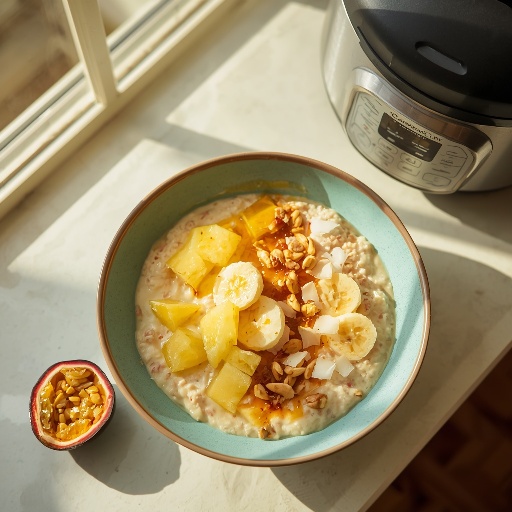
Almost every kitchen in Hawaii has a rice cooker. Using it for overnight oatmeal — set before bed, ready by morning — is one of those ideas that seems obvious once you’ve done it. This guide covers the method, the Hawaiian toppings worth knowing, and everything that can go wrong.
| 5 min | 0 min | 6–8 hrs | 2 |
| Evening prep | Morning effort | Cooker on “warm” | Servings (adjustable) |
Why the Rice Cooker Is Hawaii’s Default Kitchen Appliance
In most of mainland America, the rice cooker is an optional appliance — something people own but don’t necessarily use every day. In Hawaii, it’s different. Rice is a staple at nearly every meal, including breakfast, and the rice cooker runs constantly in most households. It sits on the counter, not in the cabinet, because putting it away would be inconvenient.
Hawaii’s food culture reflects the history of the islands — waves of immigration from Japan, Korea, China, the Philippines, and Portugal all brought food traditions that rely on rice. The plate lunch, the bento, the musubi — all of it centres around rice, and all of it requires a reliable appliance that can hold a batch warm throughout the day without attention.
On Hawaii’s food culture and rice: Hawaii’s culinary identity is deeply pluralistic. According to Wikipedia’s entry on Hawaiian cuisine, the state’s food culture developed through successive waves of plantation-era immigration, with Japanese, Chinese, Korean, Filipino, and Portuguese workers all contributing ingredients and techniques that eventually fused into what’s now considered local Hawaiian food. Rice is the common thread across virtually all of these traditions, which explains why the rice cooker is so embedded in Hawaii’s kitchen culture — and why using it for something other than rice feels entirely natural there.
Using the rice cooker for overnight oatmeal fits seamlessly into this existing habit. The appliance is already on the counter. It already has a “warm” function designed to hold food safely at temperature for extended periods. And a lot of Hawaii’s breakfast traditions — like okayu, the Japanese rice porridge sometimes eaten in the morning — share a similar texture and preparation philosophy with overnight oats.
How the Overnight Method Actually Works
There are two ways to make overnight oatmeal in a rice cooker, and they produce slightly different results. Understanding the difference helps you choose the right method for your appliance and your morning schedule.
Method 1: Cook cycle then hold on warm (best results)
Set the ingredients in the rice cooker before bed, run a full porridge or oatmeal cycle (or the “white rice” cycle if your cooker doesn’t have a specific oatmeal setting), then let the cooker switch automatically to “warm” mode. The oatmeal finishes cooking during the cycle and then holds at a safe, low temperature overnight. In the morning it’s hot, thick, and ready. This method requires a rice cooker with an automatic “keep warm” function — most modern rice cookers have this.
Method 2: Warm function only, all night (slower, creamier)
Set the rice cooker to “warm” only — not a full cook cycle — before bed. The oats cook very slowly at the lower warm temperature (typically around 65–70°C / 149–158°F) over 6–8 hours. This produces a creamier, more uniform texture than the cook-and-hold method, because the slow heat breaks down the oat starch more gradually. The tradeoff is that some rice cookers’ warm function isn’t hot enough to fully cook steel-cut oats — this method works best with rolled oats.
Food safety note: The “warm” function on most rice cookers holds food at approximately 65–74°C (149–165°F). According to USDA food safety guidelines, food held above 60°C (140°F) is considered safe from bacterial growth. Most modern rice cookers maintain warm temperatures comfortably above this threshold. However, if your cooker is older or its warm function runs noticeably cool, use Method 1 (cook cycle first) rather than relying on the warm function alone overnight.
Which Oats to Use — and Which to Avoid
| Steel-cut oats | Rolled oats (old-fashioned) | Quick oats |
| Best texture | Most reliable | Works, carefully |
| Hawaii choice | ||
| The definitive overnight rice cooker oat. Chewy, nutty, toothsome. Takes 6–8 hours on warm to fully soften — which is why overnight is ideal. Use Method 1 (cook cycle + warm) for best results. | Works well with both methods. Produces a creamier, softer result than steel-cut. Easier to scale and adjust. Good for those new to the method — more forgiving of timing variations. | Pre-processed and much thinner. Cook very fast. If left overnight, they tend to go gluey and over-thickened. Method 2 (warm only) works better than Method 1. Use less water than you’d expect. |
| Instant oats | Bob’s Red Mill Thick Rolled | Oat groats |
| Not recommended | Excellent | |
| For patient cooks | ||
| Too processed. After 8 hours of heat, instant oats become paste. Save these for single-cup microwave prep. They have no place in an overnight rice cooker recipe. | Thicker than standard rolled, closer to steel-cut in texture but with shorter cook time. Holds up extremely well overnight. Available at most Hawaii grocery stores and Costco. | Whole, minimally processed oat kernels. The most nutritious option. Takes the full 8 hours and benefits from soaking in water for 30 minutes before going into the cooker. |
The Base Recipe
This recipe is built for a standard 5–6 cup rice cooker using rolled oats or steel-cut oats. The coconut milk variation below it is the Hawaii-specific version — and honestly, it’s the better one.
Overnight rice cooker oatmeal — base recipe (serves 2)
- 1 cup Rolled oats or steel-cut oats
Rolled: use 2 cups liquid. Steel-cut: use 3 cups liquid. The ratio changes — don’t use the same amount for both. - 2–3 cups Water (or liquid — see coconut variation below)
Start with the smaller amount. You can always add liquid in the morning to loosen; you can’t remove it. - ¼ tsp Salt
Don’t skip. Oatmeal without salt tastes flat, regardless of what toppings go on top. - 1 tbsp Honey or brown sugar (optional)
Add a small amount before cooking for a very mild background sweetness. Most of the sweetness comes from toppings.
Add all ingredients to the rice cooker insert before bed. Use Method 1 (run the porridge/oatmeal cycle, or white rice cycle, then let it switch to warm) or Method 2 (warm function only for 6–8 hours). In the morning, stir well, add a splash of liquid if too thick, and top.
The coconut milk variation — the Hawaii version
This is the version that makes people ask what you did differently. Replace half the water with full-fat coconut milk. The coconut milk enriches the oats, adds a subtle sweetness, and creates a creamier texture than water alone can produce. It also connects the dish to the flavour profile of Hawaiian cooking, where coconut appears in everything from haupia dessert to coconut-braised fish.
Coconut milk overnight oatmeal — Hawaii style (serves 2)
- 1 cup Rolled oats (or ¾ cup steel-cut)
Rolled oats work better here — the coconut milk can scorch slightly with steel-cut on a full cook cycle. - 1 cup Full-fat coconut milk
Full-fat only. Light coconut milk thins out too much during the long cook and loses the richness that makes this version worthwhile. - 1 cup Water
The 1:1 coconut milk to water ratio is the sweet spot. More coconut milk and it can become very rich and slightly gluey. - ¼ tsp Salt
- 1 tsp Vanilla extract
Add before cooking. The overnight heat blooms the vanilla through the entire oatmeal. - 1 tbsp Honey or coconut sugar
Coconut sugar is the most appropriate sweetener here — it has a mild caramel note that pairs with the coconut milk.
Use Method 1 (cook cycle then warm). Coconut milk should not sit at warm temperature for 8 full hours without a prior cook cycle — run the cycle first, then let it hold warm overnight. In the morning, stir well and top with fresh tropical fruit.
Hawaiian Toppings Worth Knowing
The toppings are where this oatmeal becomes specifically Hawaiian rather than just coconut-flavoured oatmeal anywhere. Hawaii has year-round access to tropical fruits that most of the mainland encounters only in inferior, shipped versions.
| Fresh pineapple | Lilikoi (passion fruit) | Mango (local varieties) | Banana (apple bananas) |
| Year-round in Hawaii | Summer peak | May–Sept | Year-round |
| Maui Gold pineapple is less acidic and sweeter than Dole. Dice small so it distributes through the bowl. A few chunks on warm oatmeal is genuinely excellent. | Tart, intensely aromatic. Scoop the pulp directly over the oatmeal. The contrast between the rich coconut oats and the sharp lilikoi is one of the best flavour combinations on this list. | Hayden, Pirie, and White Pirie are common Hawaii varieties. Sliced over oatmeal with a drizzle of honey is a genuinely complete breakfast. | Hawaii’s apple bananas are smaller, firmer, and have a slightly tart, apple-like flavour. Far more interesting on oatmeal than standard Cavendish. Slice and add immediately before eating. |
| Macadamia nuts | Toasted coconut flakes | Papaya | Guava jam or fresh guava |
| Year-round | Year-round | Year-round | Summer–fall |
| The quintessential Hawaii nut. Toast lightly in a dry pan before adding — toasted macadamia on coconut oatmeal with fresh mango is about as Hawaiian as breakfast gets. | Adds texture and amplifies the coconut note of the base. Toast in the toaster oven at 325°F for 4 minutes — golden, not brown. | Solo papaya is the most common Hawaii variety. Mild, slightly sweet, with a musky aroma that some people love and others don’t. A squeeze of lime over fresh papaya cuts the earthiness nicely. | Strawberry guava grows wild across the Hawaiian islands. Guava jam stirred into the oatmeal or dropped on top in small spoonfuls adds a floral sweetness that no mainland fruit quite replicates. |
On Hawaii’s agricultural biodiversity: Hawaii grows more varieties of tropical fruit commercially and semi-commercially than any other U.S. state. According to the Hawaii Department of Agriculture, the state produces over 60 different tropical and subtropical fruits, including multiple mango cultivars, passion fruit, papaya, longan, lychee, rambutan, and starfruit. This biodiversity means that Hawaii residents have access to genuinely fresh, ripe tropical fruit throughout the year — a significant advantage for oatmeal toppings that most of the mainland can only approximate with shipped or frozen versions.
Variations — Six Ways to Change It Up
| Taro oatmeal | Ginger-coconut | Poi oatmeal |
| Stir 2 tablespoons of cooked, mashed taro (or taro powder) into the oats before cooking. Taro adds a subtle earthy sweetness and turns the oatmeal a pale purple-grey. A distinctly Hawaiian ingredient that works surprisingly well in a warm cereal context. | Add ½ teaspoon of freshly grated ginger to the base recipe. The ginger infuses through the overnight cook and adds a gentle warmth that balances the richness of the coconut milk. | Stir a tablespoon of fresh poi (fermented taro paste) into the cooked oatmeal in the morning. Adds a tangy, slightly sour note that’s different from anything else in breakfast cooking. Distinctly Hawaiian. Not for everyone, but very much worth trying once. |
| Peanut butter and banana | Matcha coconut | Brown sugar and macadamia |
| Stir a tablespoon of natural peanut butter into the hot oatmeal and top with sliced apple banana. A variation that takes cues from Hawaii’s Japanese-influenced breakfast tradition — not traditional, but widely made across the islands. | Whisk ½ teaspoon of ceremonial-grade matcha into 2 tablespoons of the coconut milk before adding to the cooker. The bitterness of the matcha cuts through the richness of the coconut. Top with white sesame seeds and fresh banana. | The simplest variation — add brown sugar to the base, top generously with toasted macadamia nuts and a pinch of flaky sea salt. The salt-fat-sweet combination on warm coconut oatmeal is one of the best arguments for this whole method. |
Troubleshooting — What Goes Wrong and Why
Burnt or scorched bottom
The most common problem, especially with coconut milk recipes. Usually caused by a rice cooker that runs hot on its warm setting, or by using a cook cycle that’s too aggressive for oats. Fix: grease the inner pot very lightly with coconut oil before adding ingredients. Use Method 2 (warm only) if your cooker tends to run hot. Check that the “porridge” or “oatmeal” setting is selected rather than “white rice” — white rice cycles run hotter.
Gluey, paste-like texture
Too much starch release from the oats during the long cook. Caused by using quick or instant oats, or by using too little liquid for the oat type. Steel-cut oats need more liquid than rolled oats — 3 cups per 1 cup of steel-cut versus 2 cups per 1 cup rolled. Also caused by stirring the oats during cooking — don’t open the rice cooker until morning.
Too thick in the morning
Normal and expected — oatmeal thickens considerably as it sits. Stir in ¼–½ cup of warm water, milk, or coconut milk in the morning and stir vigorously. It loosens quickly. This is why the recipe says to start with less liquid than you think — you can always add more, but a watery oatmeal is harder to correct.
Watery or undercooked oats
The warm function was too low and the oats didn’t cook through — usually indicates the rice cooker’s warm setting runs cool. Solution: always use Method 1 for steel-cut oats (run a full cycle first). For rolled oats on warm-only, extend the time to 8–9 hours. Some budget rice cookers simply don’t maintain a warm temperature high enough for slow-cooking oats reliably.
Coconut milk separated or curdled looking
Coconut milk separates naturally when heated for extended periods — the fat rises and the liquid stays below. This isn’t spoilage. Stir vigorously when you open the cooker in the morning and it will re-emulsify completely within 30 seconds. Adding the vanilla extract before cooking can help slightly — vanilla has minor emulsifying properties — but a good stir is all that’s really needed.
Rice Cooker Tips Specific to the Overnight Method
Know your rice cooker’s settings: Rice cooker models vary considerably. A basic on/off model works only for Method 1 — it runs a full cook cycle and then switches to warm automatically. A fuzzy logic or induction rice cooker typically has more nuanced settings including dedicated porridge and slow cook modes. For overnight oatmeal, the dedicated “porridge” or “slow cook” setting — where available — produces the most consistent results. If your model only has “cook” and “warm,” that’s fine — millions of bowls of overnight oatmeal have been made that way.
| Oil the pot | Don’t open overnight | Inner pot capacity |
| A very light coat of coconut oil around the inside of the pot before adding ingredients prevents sticking and scorching, particularly with coconut milk recipes. | Every time you lift the lid, heat escapes and the cook is disrupted. Set it up, close it, don’t open until morning. The temptation to check is real. Resist it. | Oatmeal expands as it cooks — don’t fill the pot more than half full before cooking. A pot that looks half-empty at night will be two-thirds full by morning. |
| Stir before tasting | Scale for one person | Cleaning note |
| The top layer of oatmeal in the rice cooker in the morning may look dry or thick. Stir thoroughly from the bottom before judging texture or flavour — the bottom layer is usually wetter and needs to be incorporated. | Half the recipe: ½ cup rolled oats, 1 cup liquid (½ coconut milk, ½ water). Most rice cookers will work fine with a smaller quantity, though the cook time doesn’t change. | Rinse the inner pot immediately after serving — oatmeal that dries in the pot is genuinely difficult to remove. A 10-minute soak in warm water handles it easily before it sets. |
See Also – Texas Ranch Water — The Original Recipe
See Also – Slow cooker beef stew without potatoes — made for a Chicago winter