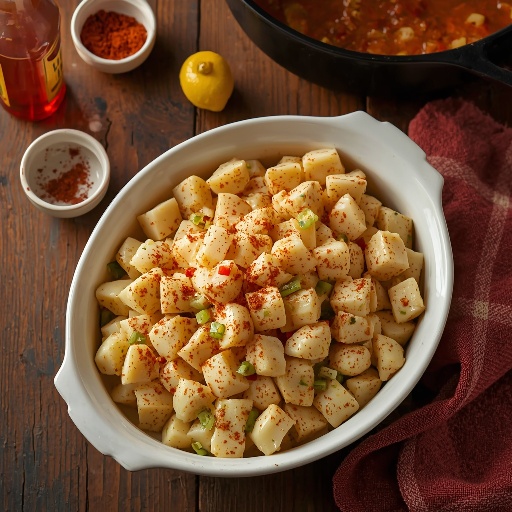
Louisiana potato salad is not the same dish as the creamy, mustard-forward versions most people grew up eating at backyard cookouts. It’s bolder, spicier, and built on a specific set of flavors that belong to the Cajun and Creole cooking traditions of South Louisiana — where food has been seasoned seriously for a very long time.
The no-mustard version in particular is less commonly found in cookbooks but more commonly made in actual Louisiana kitchens. It relies on a different flavor foundation — Cajun seasoning, cayenne, hot sauce, celery, and the Holy Trinity of Louisiana cooking — to produce something with more character than most potato salads attempt.
This article covers the full recipe, the technique, the specific ingredients that make it Cajun rather than generic, and honest variations that keep the spirit of the dish intact.
What Makes a Potato Salad “Cajun”
The word gets attached to a lot of food that isn’t particularly Cajun. So it’s worth being specific about what it actually means in this context.
A Louisiana Cajun potato salad without mustard has several defining characteristics:
The Holy Trinity. Onion, celery, and bell pepper — diced fine and incorporated into the salad — form the aromatic base that’s at the heart of virtually every Cajun dish from gumbo to jambalaya. These aren’t optional add-ins. They’re structural.
Cayenne-forward heat. Not black pepper alone. Cayenne pepper builds a sustained, warming heat that’s different from the sharp, immediate bite of black pepper. It’s the background heat that makes the salad interesting rather than just creamy.
Hot sauce. Louisiana-style hot sauce — Crystal, Tabasco, or Louisiana brand — added to the dressing rather than served on the side. The vinegar-forward heat of Louisiana hot sauce brightens the entire salad and is one of the things that makes it distinctly regional.
Cajun seasoning. A blend that typically contains paprika, garlic powder, onion powder, cayenne, and black pepper — sometimes oregano and thyme. Homemade or commercial, it ties the seasoning together.
No mustard. Mustard is common in many Louisiana potato salads, but not all. This version builds the same complexity through the spice profile rather than through the sharpness of prepared mustard. The result is different — more purely spiced, less tangy — and preferred by many Louisiana cooks.
The Full Recipe
Ingredients (Serves 8–10)
For the potatoes:
- 3 lbs (1.35 kg) Yukon Gold or red-skinned potatoes
- 1 tablespoon salt (for the boiling water)
For the dressing:
- 1¼ cups full-fat mayonnaise (Duke’s or Blue Plate for Southern authenticity; Hellmann’s works)
- 2 teaspoons Cajun seasoning (store-bought or homemade — see below)
- ½ teaspoon cayenne pepper (reduce to ¼ teaspoon for milder heat)
- ½ teaspoon garlic powder
- ½ teaspoon onion powder
- 1 teaspoon Louisiana-style hot sauce (Crystal or Tabasco)
- 1 tablespoon apple cider vinegar
- ½ teaspoon salt
- ½ teaspoon black pepper
The Holy Trinity mix:
- ½ cup finely diced yellow onion
- ½ cup finely diced celery (2–3 stalks)
- ½ cup finely diced green bell pepper
Add-ins:
- 3 hard-boiled eggs, peeled and roughly chopped
- 2 tablespoons finely sliced scallion (green onion)
- Optional: 2 tablespoons diced dill pickle or sweet pickle relish (adds a bright, briny note some families include)
Homemade Cajun Seasoning (Makes about 3 tablespoons)
If you prefer to make your own rather than use a commercial blend:
- 1 tablespoon smoked paprika
- 1 teaspoon garlic powder
- 1 teaspoon onion powder
- ½ teaspoon cayenne pepper
- ½ teaspoon dried oregano
- ½ teaspoon dried thyme
- ½ teaspoon black pepper
- ½ teaspoon salt
Mix and store in an airtight container. Use two teaspoons for this recipe.
Step-by-Step Instructions
Step 1: Cook the potatoes correctly
Place the potatoes — whole and unpeeled — in a large pot and cover with cold water by at least two inches. Add the tablespoon of salt to the water. Bring to a boil over high heat, then reduce to a steady simmer.
Cook until a knife slides through the thickest part of the largest potato without resistance — about twenty-five to thirty-five minutes depending on size. Don’t rush this by boiling hard; the potatoes can break apart and waterlog. A steady simmer is more reliable than a rolling boil.
Drain and allow to cool until they can be handled — about fifteen to twenty minutes. Peel while still warm (the skin slips off easily with warm potatoes) then cut into roughly three-quarter to one-inch chunks.
Starting with cold water rather than adding potatoes to boiling water produces more even cooking throughout. The outside and inside reach tenderness at the same time rather than the outside overcooking while the center catches up.
Step 2: Season the warm potatoes
Transfer the still-warm potato chunks to a large mixing bowl. Sprinkle with half a teaspoon of Cajun seasoning and the tablespoon of apple cider vinegar. Toss gently to coat.
This is the same technique used in Hawaiian macaroni salad and many traditional potato salad recipes — warm potatoes absorb seasoning and acid in a way that cold potatoes don’t. The vinegar penetrates the potato itself rather than sitting on the surface, which makes a real difference in the finished flavor.
Let the potatoes cool for another ten to fifteen minutes in the bowl.
Step 3: Make the dressing
In a separate bowl, whisk together the mayonnaise, Cajun seasoning, cayenne, garlic powder, onion powder, hot sauce, salt, and black pepper. Taste it before adding to the salad — it should be spicy, savory, and noticeably bold. If it seems mild, add more cayenne or hot sauce at this stage rather than at the end.
The dressing should be assertively seasoned because it will coat a large quantity of mild potato. What seems too spicy in a small bowl of dressing will be appropriately spiced in the finished salad.
Step 4: Prep the Holy Trinity and add-ins
While the potatoes finish cooling, dice the onion, celery, and bell pepper finely and uniformly. Fine dice distributes these ingredients throughout the salad without any single bite being dominated by raw onion. Rough or large pieces are one of the things that can make a potato salad feel uneven.
Chop the hard-boiled eggs — some people prefer them diced small and mixed throughout; others like larger pieces visible in the final salad. Both approaches work. Slice the scallion thinly.
Step 5: Combine
Add the dressing to the cooled potato chunks and fold gently with a spatula — not a stirring motion, which breaks the potatoes into mash. The goal is coated chunks, not puree.
Add the Holy Trinity vegetables, chopped eggs, and scallion. Fold again until everything is evenly distributed.
Taste carefully now. Adjust salt, cayenne, or hot sauce. The salad should have heat that builds slightly on the palate — not aggressive, but present and sustained.
Step 6: Chill before serving
Cover and refrigerate for a minimum of two hours before serving. Four hours is better. The potatoes continue absorbing the dressing during this time and the spices meld and deepen.
Remove from the refrigerator fifteen minutes before serving. If the salad has thickened during chilling, fold in a tablespoon or two of additional mayonnaise.
The Potato Question
Yukon Gold potatoes are the best all-purpose choice for this recipe. Their waxy, creamy texture holds together well after boiling and cutting, and their natural buttery flavor pairs well with the bold Cajun seasoning. They don’t fall apart or get waterlogged as easily as russets.
Red-skinned potatoes are another excellent option — similar waxy texture, hold their shape well, and the red skin can be left on for color and texture variation. Leaving the skin on is an entirely valid choice with red-skinned potatoes.
Russet potatoes can be used but require more care. Their starchier texture means they can break down into mash if overcooked or stirred too aggressively. Keep them slightly firmer when boiling and fold gently. The softer texture does absorb dressing more readily, which some people prefer.
New potatoes — small, thin-skinned, often sold as “baby” potatoes — are increasingly popular in potato salads. They can be halved or quartered, need no peeling, and their size produces a more rustic, visually interesting salad.
Avoid very large russets cut into big chunks — the exterior gets overcooked before the interior finishes, and large pieces don’t absorb dressing as evenly.
The Mayo: Why Brand Matters More Here Than You’d Think
This is a recipe where the mayonnaise brand genuinely shows. Louisiana potato salad from Southern grocery stores and home kitchens is typically made with Blue Plate or Duke’s mayonnaise — both are Southern-produced, slightly tangier than Hellmann’s/Best Foods, and contain no added sweeteners.
Blue Plate is the Louisiana brand, made in New Orleans, and has been used in Louisiana kitchens for over a century. It’s slightly thinner than some other brands and has a clean, eggy flavor that works well with bold seasonings.
Duke’s is the Southeastern brand, with a tangier, richer profile than Hellmann’s. It’s the preferred brand in much of the South outside Louisiana.
Hellmann’s / Best Foods works well and is widely available. The result is slightly different in flavor — a bit milder — but good.
Miracle Whip is not appropriate for this recipe. The added sweeteners and different flavor profile conflict with the savory, spicy direction of the Cajun seasoning.
If you want the most authentic Louisiana result possible, finding Blue Plate (available online or at specialty Southern grocers) is worth the effort.
Understanding the “No Mustard” Approach
Most Cajun and Southern potato salad recipes include yellow mustard or Creole mustard — sometimes a lot of it. Mustard adds tang, a slight sharpness, and color. It’s excellent in that version. So why make it without?
Some cooks find mustard overpowering in potato salad. Others are cooking for people who dislike it. And some simply prefer the flavor profile that emerges when the Cajun seasoning stands alone without mustard competing with it.
Without mustard, the cayenne and hot sauce become the dominant tangy-sharp elements. The dressing is richer and more purely spiced. The potato salad tastes less like it’s from a deli counter and more like it was made in a specific kitchen with a specific hand for seasoning.
If you want a middle-ground approach: a teaspoon of Creole mustard (rather than plain yellow mustard) added to the dressing provides a subtle complexity without the assertive mustard flavor that the recipe title avoids. It disappears into the dressing rather than announcing itself.
Cajun Potato Salad as a Gumbo Side
One of the most distinctly Louisiana serving traditions is eating potato salad directly in a bowl of gumbo — scooping a spoonful of cold, creamy potato salad into the hot, dark, intensely flavored gumbo and eating them together.
To people unfamiliar with this, it sounds unusual. To most South Louisiana natives, it sounds like Tuesday.
The contrast works because of temperature (hot gumbo, cold salad), texture (thin, rich broth against thick, creamy potato), and flavor (intensely savory and spiced gumbo against the cooler, milder spiced potato). The potato absorbs gumbo broth at the edges of the scoop and takes on a complex flavor that’s different from either dish eaten alone.
If you’ve never tried it, make this recipe and serve it alongside a bowl of chicken and sausage gumbo. Even a simple gumbo from a store-bought roux works for the first experiment. The combination is worth understanding.
Variations Worth Trying
With Andouille Sausage
Slice half a pound of andouille sausage into rounds and brown in a skillet until lightly caramelized on both sides. Cool completely and fold into the finished potato salad. The smoky, spiced sausage adds a meaty depth and a bit of chew that makes this version more of a meal than a side.
Creole Mustard Version (The Bridge)
Add one tablespoon of Creole mustard (coarse-ground, slightly sweet, available at most grocery stores) to the dressing. This is not a full mustard potato salad — the teaspoon amount adds complexity without taking over. It’s the version closest to what you’d find in New Orleans restaurant cooking rather than rural Cajun home cooking.
Red Pepper Heavy
Increase the diced red bell pepper (or substitute red for green) and add a small amount of diced roasted red pepper. Red pepper is sweeter and more robust than green; the visual difference is also notable, and the salad reads more colorful and festive.
With Shrimp
Add a half pound of cooked, peeled medium shrimp — boiled in seasoned water (Old Bay, bay leaf, lemon), cooled, and halved — to the finished salad. Shrimp potato salad is particularly common at Louisiana seafood boils and is genuinely excellent.
Serving Suggestions
Cajun potato salad belongs at the same table as virtually every classic Louisiana dish:
Crawfish boil: The cold, creamy salad against the intensely spiced crawfish is a natural pairing. The potato salad temppers the heat for people who need a break from cayenne.
Fried chicken: Louisiana fried chicken — heavily seasoned, deeply golden — alongside this potato salad is a genuinely great combination. The salad’s creaminess balances the crunch and spice of the chicken.
BBQ ribs or pulled pork: The bold Cajun spicing holds up against smoky, fatty meat in a way that a milder, mustard-based salad sometimes doesn’t.
Gumbo: As described above — in the bowl, not beside it, for the authentic Louisiana approach.
As a standalone lunch: Cold Cajun potato salad with a piece of cornbread and a glass of sweet tea is a complete meal by any reasonable standard.
Storage and Make-Ahead Notes
Cajun potato salad keeps well in the refrigerator for three to four days in a sealed container. Like most potato salads, it improves after the first twenty-four hours as the dressing fully absorbs and the flavors deepen.
The spice level may mellow slightly overnight — the cayenne heat dissipates slightly during storage. If reheating to serving temperature isn’t desired (this is always served cold), taste before serving and add a few more drops of hot sauce to restore the heat level if needed.
Do not freeze. Mayonnaise-based dressings separate when frozen, and the potato texture changes unfavorably. Make fresh and refrigerate.
Make-ahead tip: The potatoes can be cooked, seasoned with vinegar and Cajun seasoning, and refrigerated a day ahead. Make the dressing separately and store covered. Combine, add the vegetables and eggs, and fold together a few hours before serving. This spreads out the work and produces excellent results.
A Quick Reference
| Element | This Recipe’s Choice | Why |
|---|---|---|
| Potato type | Yukon Gold or red-skinned | Waxy, holds shape, creamy texture |
| Mayonnaise | Blue Plate, Duke’s, or Hellmann’s | Regional authenticity / flavor profile |
| Mustard | None | Heat built through Cajun seasoning instead |
| Heat source | Cajun seasoning + cayenne + hot sauce | Layered, sustained Cajun heat |
| Holy Trinity | Onion, celery, green bell pepper | Core Cajun aromatic base |
| Hot sauce | Louisiana-style (Crystal, Tabasco) | Vinegar-forward, regional character |
| Chill time | Minimum 2 hours, 4+ preferred | Dressing absorption and flavor melding |
| Eggs | Yes, roughly chopped | Traditional in Louisiana versions |
Final Thoughts
Louisiana Cajun potato salad without mustard is more specific than the name suggests. The Holy Trinity, the Cajun seasoning, the Louisiana hot sauce in the dressing, the Blue Plate mayo — each element is doing something deliberate. The result isn’t just a spicy version of standard potato salad. It’s something that belongs to a specific culinary tradition with a long history and a clear set of values about how food should taste.
Bold. Well-seasoned. Not shy.
Make it the day before you need it. Don’t be timid with the cayenne on the first attempt — if it seems almost too spicy in the bowl, it’ll be exactly right on the plate. And if you serve it alongside gumbo, try a spoonful in the bowl. That combination explains more about Louisiana cooking than most recipes can.
See Also – Griddle breakfast recipes for camping in Michigan
See Also – Pressure cooker pulled pork from frozen — Arizona style