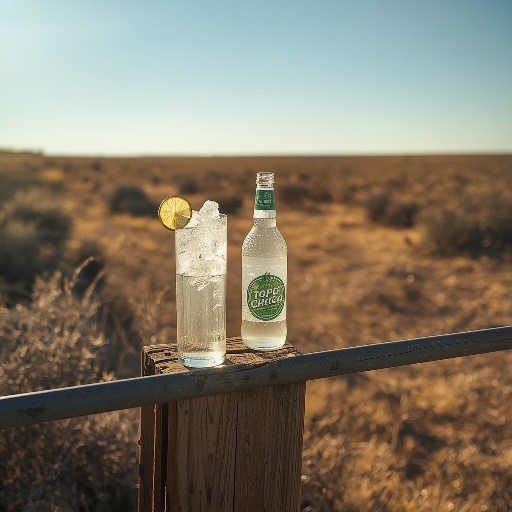
Ranch Water is one of those drinks that belongs to a place. Not invented by a bar program, not workshopped by a cocktail consultant — it came out of the heat and flat expanse of West Texas, where ranchers and oilfield workers needed something cold, refreshing, and strong enough to feel like a reward at the end of a long day.
Three ingredients. No shaking required. Done in about ninety seconds.
What follows is the original recipe, the reasoning behind each ingredient, honest variations, and everything you need to make it well.
Where Ranch Water Came From
The drink has roots in the Big Bend region of West Texas — particularly around Terlingua and the area surrounding the Gage Hotel in Marathon, where variations of this combination were reportedly being made as far back as the 1960s and 70s.
The story most often told is that it evolved naturally: someone had tequila, someone had Topo Chico, there was a lime nearby, and the combination was obvious. West Texas heat in summer is not subtle. A drink that’s cold, carbonated, citrusy, and has enough alcohol to matter became a local institution before anyone thought to name it.
The name “Ranch Water” reflects that origin. This is not a cocktail designed for a dim bar with craft ice. It’s a field drink. Something you make at a tailgate, a ranch cookout, or on a porch when the temperature hasn’t dropped below ninety degrees at sunset.
The national moment came later — sometime in the late 2010s, Ranch Water started showing up on menus across Texas, then across the country. Canned versions appeared. The original remained exactly what it always was.
The Original Three-Ingredient Recipe
Ingredients (Serves 1)
- 2 oz silver (blanco) tequila
- ½ oz fresh lime juice (about half a lime)
- Topo Chico sparkling mineral water, to top — typically 6 to 8 oz
- Ice
- Lime wedge for garnish
That’s it. No simple syrup. No triple sec. No salt rim unless you want one. The original isn’t sweet — it’s clean, acidic, carbonated, and properly boozy.
Instructions
Step 1: Choose your vessel. Ranch Water is traditionally made in a bottle or a long-neck glass — either a beer bottle with the beer poured out and the drink built inside, or a tall glass. Some people use a Collins glass; some use a pint glass. The format is casual. Whatever holds ice and liquid and can be held cold in your hand.
Step 2: Add ice. Fill your glass with ice. Crushed ice works but dilutes faster — regular cubed ice is more appropriate here and keeps the drink colder longer without watering it down before you finish it.
Step 3: Add tequila. Pour two ounces of blanco tequila over the ice. Measurement matters less here than it does in more technical cocktails, but two ounces is the baseline. Less and the drink loses its character; more and you’re making a different kind of decision.
Step 4: Add lime juice. Squeeze half a lime directly into the glass. Fresh juice only. Bottled lime juice is noticeably different in flavor — more bitter, less bright — and it shows in a drink this simple. There’s nowhere for a poor-quality ingredient to hide.
Step 5: Top with Topo Chico. Pour Topo Chico slowly and steadily over the back of a spoon or down the side of the glass to preserve as much carbonation as possible. Use a cold, freshly opened bottle. The effervescence of Topo Chico is more aggressive than standard sparkling water — it carries the drink in a way that a gentler carbonation doesn’t.
Step 6: Do not stir. Give the glass one gentle lift-and-tilt if you feel the need to combine everything, but don’t stir. Stirring destroys carbonation quickly, and the bubbles are part of what makes this drink work.
Step 7: Garnish and serve immediately. Add a lime wedge to the rim or drop it in the glass. Drink while it’s cold.
Why Each Ingredient Matters
Tequila: Blanco Only (For the Original)
Blanco tequila — also called silver or plata — is unaged or minimally aged, bottled clear, with a clean, bright agave-forward flavor. That purity is what the drink needs. An aged reposado or añejo brings vanilla, oak, and caramel notes that compete with the lime and carbonation rather than complementing them.
For the original recipe, use a mid-range 100% agave blanco. The tequila doesn’t need to be expensive, but it does need to be 100% agave — mixto tequilas (which contain sugar cane spirit alongside agave) produce a harsher, less clean result.
Decent options are widely available at any price point above about fifteen dollars a bottle. The quality threshold here is about ingredients rather than brand prestige.
Topo Chico: Not Optional in the Original
This is where people substitute and where the drink changes character most dramatically.
Topo Chico has a significantly higher mineral content and a more aggressive, persistent carbonation than most other sparkling waters. That minerality — calcium, magnesium, sodium bicarbonate — adds a subtle flavor complexity that generic sparkling water or club soda lacks. It also has a slightly saline quality that enhances the lime and the agave in a way that plain carbonated water doesn’t.
Club soda is more neutral and less carbonated. Sparkling mineral waters like Perrier or San Pellegrino are closer but still different in carbonation intensity and mineral profile. LaCroix and flavored sparkling waters are not appropriate substitutes for the original.
If Topo Chico isn’t available, Topo Chico is now owned by Coca-Cola and widely distributed across the United States. It’s rarely difficult to find. For an authentic Ranch Water, it’s worth the specific sourcing.
Lime: Fresh, Always
Half a lime per drink is the standard. Some people use slightly more — three quarters of a lime if the fruit is small or not particularly juicy. The drink should taste distinctly lime-forward without being mouth-puckeringly sour.
The ratio of lime to tequila in Ranch Water is looser than in a margarita. The Topo Chico carries the drink’s volume and dilutes both, so you can afford to lean slightly more acidic than you might in a shorter cocktail.
Juice the lime directly into the glass. Don’t strain out the seeds obsessively — this isn’t a bar presentation drink.
The Glass: Does It Matter?
More than you’d think.
The most traditional format is the long-neck beer bottle with the last inch or so of cold beer left inside when the tequila and lime are added. This produces a drink that’s slightly different — a small amount of beer mixes with the Ranch Water, which mellow the tequila slightly and add a faint malt note. Some people argue this is the true original. Others argue it’s a Ranch Water variant. Both groups are right to some degree.
For home drinking, a tall glass — Collins glass, pint glass, or any vessel that holds at least twelve ounces — works well. The drink benefits from having room for a proper amount of ice and Topo Chico without being too concentrated.
Avoid short rocks glasses. The ice-to-liquid ratio becomes wrong, the carbonation is compressed, and the drink loses the long, cold quality that defines it.
Variations That Stay True to the Spirit
Ranch Water has variations that are genuinely good without departing from what makes the original work.
Ranch Water with a Salted Rim
Run a lime wedge around the rim of the glass and dip it in coarse salt before building the drink. This is a margarita move, not strictly traditional to Ranch Water, but it works. The salt amplifies the lime flavor and adds a savory counterpoint to the clean tequila.
Tajín — a chili-lime salt blend popular throughout Texas and the Southwest — is an excellent alternative to plain salt. It adds a mild heat and a fruity depth that complements the lime particularly well.
Spicy Ranch Water
Muddle two or three thin slices of fresh jalapeño in the glass before adding ice and tequila. Or use a tequila infused with jalapeño by letting a sliced pepper steep in the bottle for twenty-four to forty-eight hours. Either approach adds heat without sweetness.
The spice from jalapeño dissolves into the carbonation in a way that creates a slow-building heat on the back of the palate — different from the immediate punch of capsaicin eaten directly. It pairs particularly well with the lime acidity.
Mezcal Ranch Water
Replace the blanco tequila with an unaged mezcal. The smoky, more complex agave character of mezcal makes the drink noticeably more interesting and more assertive. It’s a darker, more serious version of the same drink.
Use mezcal that’s not heavily flavored or excessively smoky — a lighter espadín mezcal is a better fit than an intensely peated-tasting one. The smoke should be a note, not the whole conversation.
Ranch Water Pitcher (for a Group)
Scale the recipe simply: one cup blanco tequila, half a cup of fresh lime juice, and two to three chilled bottles of Topo Chico added just before serving. Pour over ice in individual glasses rather than into a pre-made pitcher — the carbonation dissipates in an open container.
Prepare the tequila and lime mixture ahead of time and refrigerate. Add the Topo Chico at the moment of serving. This preserves the carbonation and means the host isn’t squeezing limes during the party.
What Ranch Water Is Not
A few clarifications that come up regularly:
Ranch Water is not a margarita. A margarita contains triple sec, is almost always sweetened, and is often served blended or over ice in a short glass with a salted rim. Ranch Water has no sweetener, no orange liqueur, and is always served over ice in a tall glass. They share tequila and lime but are distinct drinks.
Ranch Water is not a spiked sparkling water. Hard seltzers are a different category — lower ABV, often flavored, carbonated malt beverage base. Ranch Water is a full-strength cocktail with real tequila.
Ranch Water does not contain simple syrup. If a recipe calls for added sugar in any form, it’s a variation at best. The original is savory and acidic, not sweet.
Ranch Water is not complicated. Any recipe that includes muddling herbs, specialty syrups, or multiple modifiers is borrowing the name for something else.
Making Ranch Water for a Crowd
The logistics for a group are simple.
Set up a station: a large bowl or cooler of ice, bottles of Topo Chico kept cold until the moment they’re opened, a bottle of blanco tequila, and a pile of halved limes. Let people build their own. The recipe is simple enough that self-service works.
For a party of ten, plan on one full 750ml bottle of tequila and about ten limes. Each person goes through roughly two drinks at a casual pace over a few hours. Adjust accordingly — Ranch Water is easy drinking and people often have more than they plan to.
Keep the Topo Chico in a separate cooler until needed. Warm sparkling water is a problem that can’t be fixed quickly once it’s in the glass.
Ranch Water and West Texas Culture
The drink’s rise in national popularity tracks closely with a broader cultural interest in Texas identity — the food, the landscape, the music, the aesthetic. Ranch Water benefits from that association even for people who have never been to the Big Bend.
But the drink is genuinely good independent of its cultural story. It works because the combination of blanco tequila, aggressive carbonation, and fresh lime acidity produces something that’s greater than the sum of its parts. It’s cold when you need cold. It’s refreshing in a way that cocktails with multiple modifiers and sweeteners often aren’t. It’s simple in a way that respects the drinker’s intelligence.
West Texas isn’t a gentle environment. A drink that came out of that environment isn’t going to be fussy. That’s the whole point.
A Quick Reference
| Element | Original | Notes |
|---|---|---|
| Tequila | 2 oz blanco, 100% agave | No reposado or añejo |
| Lime | ½ oz fresh squeezed | Not bottled |
| Sparkling water | Topo Chico, 6–8 oz | Cold, freshly opened |
| Ice | Regular cubed | Not crushed |
| Sweetener | None | This is not a sweet drink |
| Glass | Tall — Collins or pint | Not a rocks glass |
| Stir | No | One gentle tilt at most |
Final Thoughts
Ranch Water earns its place in the cocktail canon not because it’s complex but because it’s correct. Every element is in the right proportion, doing the right job, with nothing extra. Three ingredients. Three minutes. Genuinely refreshing.
Make it exactly as written the first time. Once you understand what the original tastes like — clean, bright, cold, properly tequila-forward with the carbonation doing real work — you’ll know whether and how to adjust from there.
Most people don’t adjust. Most people just make it again.
See Also – Waffle iron hash browns — crispy, Oregon style
See Also – Air fryer frozen shrimp — no breading, how long, Mississippi style