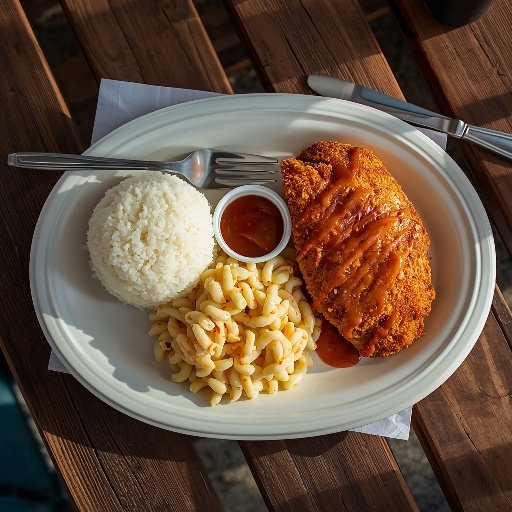
Cold, creamy, and unapologetically simple — this is the side dish that makes a Hawaiian plate lunch what it is.
What Makes Hawaiian Macaroni Salad Different from Every Other Macaroni Salad
Most macaroni salad recipes start with cooked pasta and a mayo-based dressing. Hawaiian plate lunch macaroni salad does too. But the result tastes nothing like the vinegary, vegetable-heavy versions common in mainland American cookouts. And it’s not supposed to.
Hawaiian mac salad is colder, creamier, richer, and simpler. The pasta is cooked past al dente — deliberately. The dressing is heavy on Hellmann’s (or Best Foods, as it’s called west of the Rockies), light on extras, and almost always includes a splash of apple cider vinegar and a small amount of sugar. Grated onion and shredded carrot show up in most versions. That’s largely it.
According to food historians who have documented Hawaii’s culinary history, including those affiliated with the University of Hawaii at Mānoa’s Center for Biographical Research, the plate lunch emerged in the early to mid-20th century from the plantation-era workforce culture — a labor history involving Japanese, Filipino, Korean, Portuguese, and Chinese workers eating together, trading food, and shaping a cuisine that belonged to no single ethnic tradition but drew from all of them. Macaroni salad became a fixture on the plate because it was filling, cold, and could be made in large quantities cheaply.
Understanding that history — practical, communal, unpretentious — helps explain why the salad is what it is. This isn’t a refined dish trying to be something elegant. It’s exactly what it set out to be.
The Plate Lunch: Context for the Salad
To understand the macaroni salad, you need to understand the plate it sits on.
A traditional Hawaiian plate lunch consists of two scoops of white rice, one scoop of macaroni salad, and a protein — most commonly chicken katsu, kalua pork, garlic shrimp, teriyaki beef, loco moco, or ahi poke. The meal is served on a styrofoam plate (or these days sometimes cardboard), usually from a roadside stand, a food truck, a plate lunch restaurant, or a school cafeteria fundraiser.
The rice and macaroni salad are not afterthoughts. They’re structural. The rice absorbs the sauce from the protein. The cold, creamy mac salad provides contrast — temperature contrast, texture contrast, richness against spice. Remove either one and the plate loses its internal logic.
This is worth saying because it explains why Hawaiian macaroni salad should never be treated as a canvas for improvisation. Making it sharp with mustard or adding pickles or fresh herbs misunderstands what the salad is supposed to do within the meal.
The Non-Negotiable Ingredients
The Pasta
Elbow macaroni. Not penne, not rotini, not ditalini. Elbows. The curved shape holds the dressing in its hollow center, and the size is right for the ratio of pasta to sauce that makes this work.
Cook it beyond al dente — this is one of those cases where conventional pasta-cooking advice doesn’t apply. You want the macaroni soft, almost pillowy. When you bite a piece, it should give immediately with no resistance at the center. Undercooked macaroni in this salad doesn’t absorb the dressing properly, and the result is pasta floating in mayo rather than pasta that has become one with the dressing.
The Mayonnaise
In Hawaii, this means Best Foods (Hellmann’s on the mainland) or Kewpie Japanese mayonnaise. Most local recipes use Best Foods. Some add a mix of both — Best Foods provides the volume and the familiar flavor, while Kewpie adds extra richness and a slightly eggy depth from its higher yolk content.
Whatever you use, don’t try to reduce the amount to make it feel lighter. The quantity of mayonnaise in this recipe is the point. Halving it produces a dry, underseasoned salad that bears no resemblance to what you’d get at Rainbow Drive-In or L&L Hawaiian Barbecue.
Apple Cider Vinegar
A small amount of acid is essential. It balances the richness of the mayonnaise and brightens the flavor without being detectable on its own. The salad should not taste vinegary — if it does, you’ve used too much.
Grated Onion
Not diced. Not sliced. Grated, on the fine side of a box grater. Grated onion distributes evenly throughout the salad, releases its juice into the dressing, and provides flavor without any crunchy or sharp onion pieces that would interrupt the salad’s smooth texture.
Sugar
A small amount — typically a teaspoon or two — rounds out the dressing and is part of what makes Hawaiian mac salad taste distinctly itself. It’s not sweet enough to taste sweet. It just fills in the background in a way that’s hard to identify but immediately noticeable when it’s absent.
Shredded Carrot
Grated or finely shredded carrot adds a small amount of color and a subtle sweetness. Traditional versions include it; some families skip it. It’s not structural in the way the other ingredients are, but it’s traditional.
Whole Milk (for the Hot Pasta Step)
This is the technique detail that most recipes outside Hawaii leave out, and it’s one of the most important parts of making this properly. More on this in the method section.
The Full Recipe
Ingredients (Serves 8–10 as a side)
- 1 lb (450g) elbow macaroni
- 2 cups Best Foods / Hellmann’s mayonnaise (full-fat — this is not negotiable)
- 3 tablespoons apple cider vinegar, divided
- ¼ cup whole milk
- 1½ teaspoons sugar
- ½ teaspoon salt, plus more to taste
- ¼ teaspoon white pepper (or black pepper if white isn’t available)
- ½ small yellow onion, grated on the fine holes of a box grater
- 1 large carrot, peeled and finely grated
- 2 stalks celery, very finely diced (optional — some versions include this, some don’t)
Optional Add-Ins (Traditional Variations)
- 2 tablespoons Kewpie mayonnaise (in addition to, not replacing, the Best Foods)
- 1 teaspoon garlic powder (some families include this)
- 2 to 3 green onions, thinly sliced — added just before serving, not in the dressing
Step-by-Step Instructions
Step 1: Cook the Pasta Correctly (This Step Is Different Here)
Bring a large pot of well-salted water to a boil. Add the macaroni and cook for 2 to 3 minutes longer than the package directions indicate — so if the package says 7 minutes for al dente, cook for 9 to 10 minutes. Taste as you go. You want soft, fully yielding pasta with no bite.
Drain the pasta but do not rinse it. Rinsing removes surface starch that helps the dressing adhere to the pasta. Set the hot, drained pasta aside in the pot or in a large bowl.
Step 2: The Hot Pasta Dressing — The Critical Technique
While the pasta is still very hot, immediately add 1 tablespoon of the apple cider vinegar and ¼ cup of whole milk. Stir to coat the pasta completely. This step sounds unusual, and it is — most macaroni salad recipes wait for the pasta to cool before adding any dressing.
Here’s why it matters: hot pasta is porous and absorbs liquid readily. When you add milk and a small amount of vinegar while the pasta is steaming hot, the pasta soaks up this liquid and becomes tender, creamy, and slightly tangy at the core — not just coated on the outside. This is what gives Hawaiian mac salad its characteristic texture that’s different from a standard cold pasta salad where the dressing just sits on top.
Let the pasta sit for 10 minutes with the milk and vinegar stirred through, then let it cool to room temperature. Stir occasionally to prevent clumping.
Step 3: Make the Dressing
In a bowl, whisk together the mayonnaise, remaining 2 tablespoons of apple cider vinegar, sugar, salt, and white pepper. Add the grated onion (and its liquid — don’t squeeze it out) and the grated carrot. Mix to combine.
Taste the dressing. It should taste rich, very slightly tangy, with a faint sweetness in the background. Adjust salt and sugar if needed. The dressing will seem quite thick at this stage — that’s correct. It will loosen slightly when stirred into the pasta.
Step 4: Dress the Pasta — First Round
Once the pasta has cooled to room temperature (not cold from the refrigerator — still at room temp), add about two-thirds of the dressing. Fold gently to coat every piece of macaroni. The pasta will absorb a significant amount of the dressing at this stage.
Cover and refrigerate for at least 2 hours, preferably 4 or overnight.
Step 5: Add the Remaining Dressing Before Serving
This is the second critical technique detail. After the salad has chilled, it will look dry — the pasta absorbs the dressing as it sits. Before serving, add the remaining third of the dressing and fold through. This restores the creamy, glossy appearance of the finished salad.
If it still looks thicker than you want, add an extra spoonful of mayonnaise and stir through. Taste again and adjust salt.
Serve cold — directly from the refrigerator. Hawaiian mac salad is not served at room temperature.
The Texture Question: Why Overcooking the Pasta Is Correct Here
This trips people up, especially anyone who has spent time learning to cook pasta properly for Italian dishes.
In Italian cooking, al dente is a textural virtue — pasta with a firm center that provides resistance when bitten. That firmness is exactly what you don’t want in Hawaiian mac salad.
Soft pasta in this context absorbs the creamy dressing and becomes something unified rather than something separate — a bowl of pasta with sauce on it. The goal is for the pasta and dressing to integrate fully so that each forkful is consistent throughout: equally creamy, equally soft, equally flavored.
Restaurants in Hawaii that make hundreds of pounds of this salad every week know this and cook the pasta accordingly. Don’t fight the technique.
Why the Two-Step Dressing Method Matters
Most home cooks who attempt Hawaiian mac salad make it once, find it good but slightly dry with the dressing too thin after chilling, and don’t understand why.
The reason is simple: pasta is absorbent. It keeps absorbing moisture in the refrigerator, and after several hours the salad looks and tastes less creamy than it did right after mixing.
The solution — reserving a third of the dressing to add before serving — is the standard approach in Hawaii, though it rarely appears in recipes written for a mainland audience. It’s one of those pieces of institutional knowledge that gets passed from person to person in a kitchen, not printed in a recipe card.
Do it once, and the difference is immediately obvious.
Serving Hawaiian Mac Salad: The Plate Lunch Setup at Home
Building the Plate
To serve this as part of an authentic plate lunch at home, you need: two scoops of white rice (Japanese short-grain is most traditional, though medium-grain works), one scoop of macaroni salad, and a protein.
The scoop is part of the visual language of the plate lunch. An ice cream scoop or a rice bowl used as a mold gives you the rounded, symmetrical portion that defines how the plate looks. Place the scoops side by side, then add the protein alongside or on top. Sauce from the protein goes over the rice, not the macaroni salad.
Protein Pairings
The salad pairs well with anything saucy or boldly flavored — the creaminess and mild flavor of the mac salad provide a reset between bites of something more intense.
Chicken katsu with tonkatsu sauce is probably the most classic pairing. Kalua pork — slow-cooked until it shreds, seasoned with Hawaiian salt and liquid smoke — is equally traditional. Garlic shrimp (inspired by the shrimp trucks of the North Shore on Oahu) works well, especially if the shrimp are buttery and garlicky enough to contrast with the cold, creamy salad.
Loco moco — a hamburger patty over rice with a fried egg and brown gravy — is the comfort food extreme version, and the mac salad alongside makes the whole plate significantly more manageable.
Variations That Stay Within the Tradition
Tuna Mac (A Common Variation)
Mix a drained can of albacore tuna into the finished salad before the final dressing addition. This turns the side dish into a more substantial standalone item. Some people add a small amount of diced celery and a teaspoon of Dijon mustard when tuna goes in — this is the one version where a bit of mustard isn’t out of place, since the tuna shifts the flavor profile enough to accommodate it.
Extra Creamy Version
Mix equal parts Best Foods and Kewpie mayonnaise. The Kewpie adds additional richness and a slightly more golden color. This is common in some home kitchens in Hawaii and produces a noticeably silkier result.
With Green Onion and Sesame
Add sliced green onions and a very small drizzle of toasted sesame oil stirred into the dressing. This is a mild nod to the Japanese influences in Hawaii’s plantation food culture and stays consistent with the dish’s broader heritage. Don’t overdo the sesame oil — it should be a whisper, not a feature.
Make-Ahead and Storage
The Best Timeline
This salad is better the longer it sits, up to a point. Making it the night before allows the pasta to fully absorb the first round of dressing and gives the flavors time to meld. The morning of serving, add the reserved dressing, stir through, and taste before putting it on the table.
For a party, a large catering batch can be made two days ahead with no quality loss — the pasta just becomes progressively more integrated with the dressing, which is the right direction to travel.
How Long It Keeps
Refrigerated in an airtight container, Hawaiian mac salad keeps for 3 to 4 days. After that, the pasta becomes mushy and the dressing starts to separate slightly. The first and second day are peak quality. Still good on the third. By the fourth day, use your judgment.
Don’t Freeze It
Mayonnaise-based salads don’t freeze well. The emulsion breaks during freezing and thawing, leaving a separated, watery mess. This isn’t the kind of dish you make ahead to freeze — it’s made fresh for the occasion.
A Few Notes on Scaling
This recipe scales up easily. For a large group — a backyard party, a potluck, a school fundraiser — multiply everything proportionally. The only adjustment worth making at scale is to slightly reduce the total mayonnaise by about 10% from the scaled amount, since large quantities of pasta tend to be more tightly packed and need marginally less dressing per unit volume. Taste and adjust.
Large batches also benefit from a longer initial rest before the final dressing addition — at least 6 hours in the refrigerator, ideally overnight.
The Culinary Institute of the Pacific at Kapiolani Community College in Honolulu, one of Hawaii’s leading culinary programs, teaches the traditions of Hawaiian regional cuisine including plate lunch culture and the techniques behind dishes like this one. Understanding the institutional context of where Hawaiian food is taught and documented helps underscore that plate lunch macaroni salad isn’t a casual accident — it’s a deliberate, technically specific dish with a correct way to be made.
Why This Recipe Has Only a Few Ingredients
People sometimes look at the short ingredient list and assume something is missing. Nothing is missing.
Hawaiian mac salad resists improvisation not because it’s rigid but because it’s precisely calibrated to do a specific job on a specific plate. Add too many vegetables and it starts competing with the protein for textural interest. Add mustard or pickle relish and the sharpness undermines the creamy neutrality that makes it such an effective foil for the saucy, savory proteins it sits next to.
The simplicity is the skill. Getting a five-ingredient dish right is harder than getting a fifteen-ingredient dish approximately right.
Summary: Getting It Right the First Time
The three things that distinguish properly made Hawaiian plate lunch macaroni salad from a generic version are: pasta cooked soft and dressed while still hot with milk, enough mayonnaise to look like slightly too much, and the two-step dressing method with dressing reserved and added before serving.
Get those three things right and the rest takes care of itself. It’s a straightforward recipe that rewards attention to a small number of specific technique details — which is true of almost every dish that has survived and thrived for generations.
See Also – Muffin tin dinner recipes for busy New York families