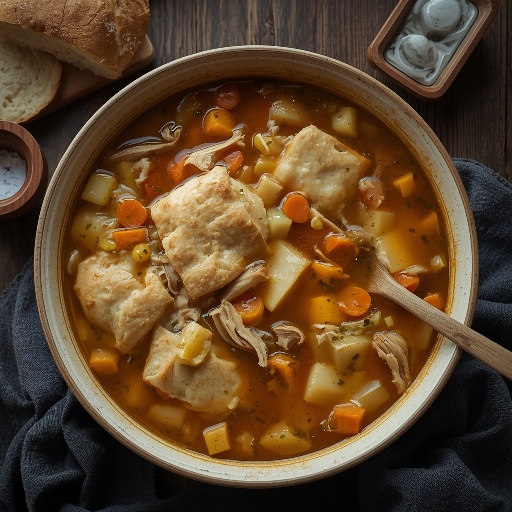
Not a pie with a crust on top. Not what you grew up seeing in the freezer aisle. This is the original — thick, doughy, and completely its own thing.
Why Pennsylvania Dutch Pot Pie Is Unlike Any Other
If you’re from central or southeastern Pennsylvania, you already know. If you’re not, this probably requires an explanation.
Pennsylvania Dutch chicken pot pie — the old-style version — is not a pastry-crusted pie baked in a dish. It’s a thick, stew-like dish made with hand-cut or hand-rolled dough squares cooked directly in a rich chicken broth with vegetables and pulled chicken. The dough pieces are dense and slightly chewy, nothing like puff pastry, nothing like pie crust. They’re more like a cross between a thick egg noodle and a dumpling. And the whole thing is cooked on the stovetop in one pot.
According to food historians who document regional American foodways, including those at Penn State’s Pennsylvania Center for the Book, the Pennsylvania Dutch — descendants of German-speaking settlers from Switzerland and the Rhineland who arrived in Pennsylvania in the 17th and 18th centuries — developed a cuisine rooted in practical, hearty, peasant-style cooking. Pot pie, called Bott Boi in Pennsylvania Dutch dialect, was a way to stretch a single chicken into a filling meal for a large family.
It’s a dish rooted in utility and technique, not in refinement. And that’s exactly why it’s so satisfying.
What “Pennsylvania Dutch” Actually Means
The term “Pennsylvania Dutch” has nothing to do with the Netherlands. The word “Dutch” in this context is an anglicization of Deutsch — meaning German. Pennsylvania Dutch people are primarily descended from German-speaking Anabaptist groups: Amish, Mennonites, and other communities who settled in Lancaster County, Berks County, Lebanon County, and surrounding areas beginning in the early 1700s.
Their cooking reflects German peasant traditions adapted to available ingredients in the New World — heavy on pork, potatoes, cabbage, and poultry, with a preference for thick gravies, stewed dishes, and pickled preserves.
Pennsylvania Dutch pot pie belongs firmly to this tradition. It’s filling, economical, and built for cold weather. A pot of it on the stove in January makes a farmhouse kitchen smell like everything a winter meal should smell like.
The Key Ingredient Nobody Outside Pennsylvania Talks About: Pot Pie Squares
The dough squares — sometimes called pot pie noodles, pot pie pieces, or simply “pot pie” (the noodle being synonymous with the dish in Pennsylvania Dutch communities) — are what make this recipe what it is.
They’re not difficult to make. The dough is simple: flour, egg, salt, and a small amount of fat, mixed and rolled out, then cut into rough squares or rectangles. When dropped into simmering broth, they cook to a tender but still-substantial chew. They thicken the broth as they cook by releasing starch, so the finished pot pie has a thick, glossy consistency without any flour or cornstarch roux.
This is one of those cases where the technique does the work. The dough pieces are both a structural element and a thickener — doing double duty in a dish that was built around efficiency.
Some families in Pennsylvania still make these by hand every time. Others use pre-cut pot pie squares from local Pennsylvania grocery stores, which are sold dried, similar to pasta. If you live outside Pennsylvania, making them from scratch is the only real option — and it’s straightforward.
The Full Recipe: Pennsylvania Dutch Chicken Pot Pie, Old Style
Ingredients (Serves 6–8)
For the chicken and broth:
- 1 whole chicken (3½ to 4 lbs), or equivalent bone-in, skin-on pieces (thighs and legs give the richest broth)
- 3 quarts cold water
- 2 stalks celery, roughly chopped (leaves included — they add flavor)
- 2 medium carrots, roughly chopped
- 1 large yellow onion, quartered (skin on is fine — it deepens the color)
- 4 cloves garlic, smashed
- 1 bay leaf
- 8 to 10 whole black peppercorns
- 1½ teaspoons kosher salt
For the pot pie dough:
- 2 cups all-purpose flour, plus more for rolling
- ½ teaspoon salt
- 1 large egg, beaten
- ¼ cup cold water (approximately — add a tablespoon at a time)
- 1 tablespoon butter, softened (or lard — the traditional fat)
For the finished pot pie:
- The strained, seasoned chicken broth (approximately 2 to 2½ quarts after simmering)
- All the pulled chicken, skin and bones removed
- 3 medium Yukon Gold potatoes, peeled and cut into ¾-inch cubes
- 2 medium carrots, sliced into ½-inch rounds
- 2 stalks celery, sliced
- 1 medium onion, diced
- 3 tablespoons fresh flat-leaf parsley, chopped
- Salt and pepper to taste
- Pinch of saffron (optional — traditional in some Pennsylvania Dutch recipes, adds a golden color and subtle flavor)
Part One: Making the Broth
Why You Start with a Whole Chicken
The broth is the foundation of this dish, and a good broth requires bones, skin, and time. A whole chicken simmered for two hours produces a broth with body, depth, and the faint richness that comes from collagen releasing from the joints. You cannot replicate this with boneless chicken breasts and store-bought broth. The technique is inseparable from the result.
Instructions
Place the whole chicken in a large pot — at least 8 quarts — and cover with cold water. Cold water is important. Starting in cold water draws out more flavor and produces a clearer broth than starting in already-hot liquid.
Add the celery, roughly chopped carrots, quartered onion, garlic, bay leaf, and peppercorns. Do not add salt yet in significant amounts — a pinch is fine, but heavy salting at this stage can result in an over-concentrated broth as water evaporates.
Bring slowly to a boil over medium heat. As it heats up, foam will rise to the surface — skim this off with a spoon or ladle. This step isn’t essential, but it produces a cleaner, clearer broth. Once you’ve skimmed the main foam (the first 5 to 10 minutes of simmering), you don’t need to continue.
Reduce to a gentle simmer. A proper broth simmer means bubbles breaking the surface occasionally but no aggressive rolling boil. High heat makes broth cloudy and can toughen the chicken meat. Cook for 90 minutes to 2 hours, until the chicken is completely cooked through and the meat is beginning to pull away from the bone.
Remove the chicken from the pot and let it cool on a cutting board until cool enough to handle.
Strain the broth through a fine-mesh strainer into a large bowl or second pot, discarding the spent vegetables. Taste and season with salt. The broth should taste rounded and full — not bland, not sharp, not aggressively salty. This is your flavor baseline for the whole dish.
Pulling the Chicken
Once cool enough to handle, pull the chicken meat off the bones by hand. Discard the skin and bones. Pull the meat into pieces — not uniform chunks, not too fine. Rough, uneven pieces about 1 to 2 inches are right. They’ll continue to cook briefly in the broth and hold their texture better if they start a bit larger.
Set the pulled chicken aside. At this point, you have a rich broth and a pile of pulled chicken — the two core components of the dish.
Part Two: Making the Pot Pie Dough
The Dough Formula
This dough is simple and unfussy. No yeast, no leavening, no resting time. It behaves more like pasta dough than pie crust dough.
In a large mixing bowl, combine the flour and salt. Make a well in the center and add the beaten egg and softened butter. Mix with a fork, then with your hands, adding cold water a tablespoon at a time until the dough comes together into a firm, smooth ball. It should not be sticky or wet — if it is, add a small amount of flour. It should not be crumbly and dry — if it is, add a few drops more water.
Knead briefly on a lightly floured surface for 1 to 2 minutes, just until the dough is smooth and cohesive. This is not bread dough — you’re not trying to develop gluten aggressively. You just want it to hold together.
Rolling and Cutting
Divide the dough into two pieces for easier handling. On a floured surface, roll each piece out to about ⅛-inch thickness — relatively thin, not paper-thin. The dough will puff slightly as it cooks, so rolling it a bit thinner than feels right is usually the correct instinct.
Cut into rough squares or rectangles, anywhere from 1½ to 2½ inches across. Traditional pot pie squares are not perfectly uniform. Some grandmothers cut them with a knife in a grid pattern; others pull irregular pieces by hand. The slight irregularity is part of the visual character of the dish and makes no practical difference to how they cook.
Dust the cut squares lightly with flour to prevent sticking and set aside on a floured baking sheet or plate until ready to use.
Part Three: Building the Pot Pie
Adding the Vegetables
Return the strained broth to the pot and bring to a gentle boil. Add the diced onion, sliced carrots, celery, and cubed potatoes. Cook for 10 minutes, until the vegetables are starting to become tender but not fully cooked — they’ll finish cooking with the dough.
If using saffron, add a small pinch now. It will bloom in the hot broth and contribute a faint earthy sweetness and a golden hue that’s characteristic of some regional versions of this dish.
Adding the Dough Squares
This is the step that defines the dish. Slide the dough squares into the simmering broth one at a time, shaking off excess flour as you go. Don’t dump them in all at once — they’ll clump together. Add them gradually, stirring gently between additions to keep them separate.
Once all the squares are in, stir every minute or two to prevent sticking. The dough will absorb broth and swell noticeably. The starch released from the squares will thicken the broth into a gravy-like consistency — this happens naturally and is the hallmark of properly made pot pie. No cornstarch slurry needed. No roux.
Cook for 15 to 20 minutes over medium heat, stirring gently and regularly, until the dough squares are cooked through — tender but with a slight chew, not mushy. Cut one open to check. The inside should be cooked through with no raw doughy center.
Adding the Chicken Back In
Once the dough squares are nearly done, add the pulled chicken back to the pot. Stir gently to distribute. Let it heat through for 3 to 5 minutes.
Add the fresh parsley. Taste and adjust salt and pepper. The finished pot pie should be thick — closer to a very thick stew than a thin soup — with the broth clinging to the dough pieces rather than pooling loosely in the bowl.
Texture: What Old-Style Pot Pie Should Feel Like
Thick, Not Soupy
Pennsylvania Dutch pot pie should be able to support a spoon stuck upright for a moment. Not cement-thick, but substantially thicker than soup. The starch from the dough squares is doing all the thickening work, and if the broth is still very thin after the dough has cooked, the pieces probably haven’t cooked long enough, or the initial broth was too watery.
Chewy, Not Mushy Dough
The squares should have some substance to them. They should offer a slight resistance when bitten — not the hardness of undercooked pasta, but not the uniform softness of an overcooked dumpling. Cooking time matters here, and so does the thickness to which you rolled the dough. Thicker squares take longer and stay chewier; thinner squares cook faster and soften more. Neither is wrong — different families have strong preferences.
What Overcooked Looks Like
If the dough squares start to dissolve and disappear into the broth, they’ve cooked too long or were rolled too thin. The broth will become very thick and almost gluey. This is still edible, but it’s not the right texture — it lacks the structural interest of properly cooked squares. A short cook time and attentive stirring prevent this.
Regional Variations Within Pennsylvania Dutch Country
Lebanon County vs. Lancaster County
Even within Pennsylvania Dutch country, there are family-to-family and county-to-county variations. Some families add hard-boiled egg slices to the finished pot pie — a traditional addition that adds richness and a slightly different texture. Some add sliced mushrooms to the broth during cooking. Some use a pinch of saffron, and others consider that an unnecessary embellishment.
In some households, the dough is enriched with an extra egg yolk, making the squares more golden and a bit more tender. In others, the dough is leaner — just flour, salt, and water — which produces a slightly denser, chewier square.
None of these is the definitive version. They’re all Pennsylvania Dutch pot pie, shaped by the particular family that made it.
The Saffron Question
Pennsylvania Dutch cooking has a centuries-old tradition of using saffron — unusual for a cuisine that is otherwise fairly austere in its spice use. Food historians believe this connection to saffron traces back to the early German settlers who brought the spice with them. Lancaster County even had a small saffron farming industry in the early 19th century.
According to Smithsonian Magazine’s documentation of Pennsylvania Dutch food traditions, saffron appears in several traditional Pennsylvania Dutch dishes, including chicken pot pie, chicken corn soup, and various baked goods — a culinary fingerprint unlike anything else in American regional cooking.
Adding a pinch isn’t required and won’t make or break the dish. But if you want to honor the older tradition, it’s worth using.
Common Mistakes and How to Fix Them
The Broth Is Too Thin at the End
This usually means either the dough didn’t cook long enough to release adequate starch, or the original broth was too diluted. If the finished pot pie is thinner than you want, remove a cup of the broth, whisk in a tablespoon of flour, return it to the pot, and stir over medium heat for a few minutes. This is a quick fix that works without affecting flavor significantly.
The Dough Squares Are Stuck Together
This happens when they’re added too quickly or when the broth isn’t at a rolling enough simmer. Make sure the broth is actively simmering before the dough goes in, and add the squares gradually while stirring. A light dusting of flour on the squares before they go in also helps prevent clumping at the surface.
The Chicken Is Dry and Stringy
Overcooking chicken during the initial broth-making stage — especially a full boil rather than a gentle simmer — produces dry, stringy meat. Keep the simmer gentle. The chicken should be cooked through but still moist. If you’ve overcooked it slightly, more broth and a shorter final simmer time will help.
The Dough Tastes Raw
This means the squares were added too late or the pot was taken off the heat too early. Raw dough has a chalky, pasty quality that’s unmistakable. Add the squares with enough time to cook through — a minimum of 15 minutes at a steady simmer — and cut one open to confirm it’s done before serving.
Serving Pennsylvania Dutch Pot Pie
Traditional Serving
Old-style pot pie is served in large bowls, family-style, often with a ladle so people can take as much as they want. There is no garnish that belongs on traditional pot pie — parsley in the pot is optional and traditional; a sprig of something on top of the bowl is not. Bread alongside — a simple white or whole wheat loaf — for soaking up extra broth is appropriate and common.
Salt and pepper on the table. Nothing else is needed.
What It Doesn’t Need
It doesn’t need cheese. It doesn’t need a pastry lid placed over the top before serving to make it look more like conventional pot pie. It doesn’t need cream added at the end to make it richer. These are attempts to make it into something else, and they undermine the dish’s own particular character.
Making It Ahead and Storing Leftovers
Make-Ahead Strategy
The broth and pulled chicken can be made entirely a day ahead. Refrigerate them separately. The next day, skim any solidified fat off the top of the broth (or leave it in for richness — your choice), reheat, and proceed from the vegetable-adding step. The dough is best made fresh on the day of serving.
Storing Leftovers
Leftover pot pie keeps in the refrigerator for 3 days. The dough squares will continue to absorb broth as it sits, so the leftovers will be thicker than the original serving — almost solid in some cases. Reheat with a generous splash of water or additional broth over medium-low heat, stirring frequently. It comes back together well.
Freezing
The broth and chicken freeze well. The finished pot pie with dough squares does not freeze particularly well — the dough breaks down during freezing and thawing and loses its texture almost entirely. Freeze the components separately and make fresh dough when you’re ready to reheat.
Why This Recipe Matters Beyond the Dish Itself
Pennsylvania Dutch pot pie is not a recipe that shows up in trendy food writing or gets photographed for glossy cookbooks. It’s humble, brown, and utterly unfashionable in appearance. It looks, as mentioned at the start, like a mess.
But it carries something that more visually impressive dishes often don’t: a direct, uninterrupted line back to the women who made it in stone farmhouses in Lancaster County three hundred years ago, stretching a single chicken across a meal that had to feed a family through a winter evening. The technique hasn’t changed. The ingredients haven’t changed. The result hasn’t changed.
There’s something valuable about learning to cook something like this exactly as it was always done, without modernizing it or streamlining it or photographing it for the feed. Some dishes deserve to be left alone.
See Also – Griddle breakfast recipes for camping in Michigan
See Also – Pressure cooker pulled pork from frozen — Arizona style