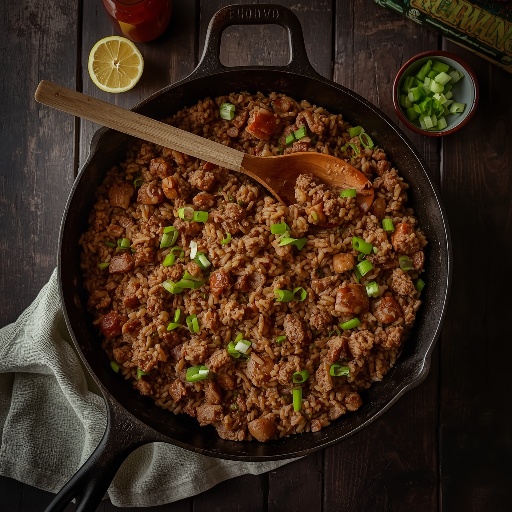
This is the real thing — not the box version, not a shortcut. Here’s how Louisiana dirty rice is actually supposed to be made.
What Dirty Rice Is and Where It Comes From
Dirty rice is one of those dishes that sounds like it shouldn’t work until you taste it. The name comes from the appearance — long-grain white rice cooked with ground meat, chicken livers, and aromatics that turn it a deep, mottled brown. It looks, frankly, like a mess. It tastes like one of the best things you’ve ever eaten off a plate in the American South.
According to food historians and the Louisiana Culinary Institute, dirty rice is a foundational dish of Creole and Cajun cooking — two related but distinct culinary traditions that developed in Louisiana from a complex mix of French, Spanish, African, and Native American influences. The use of organ meats like chicken livers and gizzards reflects the practical tradition of using every part of the animal, a necessity that became, over generations, a genuine point of regional pride and culinary identity.
It’s a dish with deep roots, and making it properly matters. This article gives you the full recipe from scratch — nothing from a box, nothing reconstituted — along with the context and technique that makes the difference between good dirty rice and genuinely great dirty rice.
The Holy Trinity: The Flavor Foundation of Louisiana Cooking
Before getting into the specific recipe, it helps to understand the base on which almost every Cajun and Creole dish is built.
What the Holy Trinity Is
Louisiana cooking is built on a trio of aromatics: onion, celery, and green bell pepper. This combination is sometimes called the “holy trinity” of Cajun and Creole cooking — a reference to the French mirepoix (onion, celery, carrot) that was adapted when bell pepper replaced the carrot in Louisiana kitchens. Many recipes also add garlic as a fourth element, though purists consider garlic a separate supporting player.
These three vegetables cooked down slowly in fat — until soft, sweet, and fragrant — form the flavor backbone of dirty rice, gumbo, jambalaya, étouffée, and countless other Louisiana dishes. Getting this step right is more important than any other single technique in this recipe.
Why It Matters Here
Dirty rice doesn’t have a long ingredient list. The complexity of flavor in the finished dish comes almost entirely from two sources: the depth built from properly cooked aromatics and the intensity contributed by the chicken livers. Skip either step or rush it, and the rice tastes flat. Give both the time they need, and you get something that tastes like it cooked for far longer than it did.
Understanding Chicken Livers in This Recipe
This is the ingredient that makes people hesitate. If you’re skeptical about chicken livers, or if you’ve had them prepared badly somewhere and written them off, this section is for you.
What Chicken Livers Do in Dirty Rice
Chicken livers don’t show up whole or as a recognizable piece in finished dirty rice. They’re minced or finely chopped and cooked with ground pork or beef, then stirred into the rice. By the time the dish is done, they’re part of the overall texture — adding a richness, depth, and savory intensity that no other ingredient replicates.
The liver flavor is present but not dominant. People who eat dirty rice without knowing what’s in it often can’t identify the specific ingredient — they just know the dish has a depth of flavor that plain meat-and-rice doesn’t. That’s the livers working.
Preparing Chicken Livers Properly
Raw chicken livers have a slightly metallic smell that can be off-putting and contributes to the reputation they don’t entirely deserve. A brief soak in cold milk or cold water for 20 to 30 minutes before cooking draws out some of the blood and significantly mellows the flavor.
After soaking, drain and pat them completely dry before cooking. Wet livers steam rather than sear, and steamed livers develop a grainy, unpleasant texture. Dry livers seared over high heat get golden and slightly caramelized on the outside — a completely different eating experience.
Trim away any connective tissue or greenish spots (from bile) that you notice — these contribute bitterness if left in.
Sourcing and Food Safety
Chicken livers are perishable and should be used within one to two days of purchase. Cook them to an internal temperature of 165°F. The USDA’s food safety guidelines for poultry specify that all poultry products, including organ meats, should reach this temperature before consumption. Unlike beef liver, which some preparations leave pink in the center, chicken liver should be cooked through — though not to the point of being chalky and dry, which happens quickly if you overcook them.
The Full Recipe: Louisiana Dirty Rice with Chicken Livers
Ingredients (Serves 6–8 as a side, 4 as a main)
The proteins:
- ½ lb (225g) chicken livers, soaked in cold milk for 20–30 minutes, drained, dried, and finely chopped
- ½ lb (225g) ground pork (or bulk pork sausage, mild)
- ¼ lb (115g) ground beef (80/20)
The holy trinity:
- 1 large yellow onion, finely diced
- 3 stalks celery, finely diced
- 1 large green bell pepper, finely diced
- 5 cloves garlic, minced
The rice:
- 2 cups long-grain white rice (uncooked)
- 3½ cups chicken stock (low-sodium recommended — you control the salt)
The fat:
- 3 tablespoons vegetable oil or lard (lard is traditional and adds flavor)
The seasoning:
- 1½ teaspoons kosher salt (adjust to taste)
- 1 teaspoon black pepper
- 1 teaspoon smoked paprika
- ½ teaspoon cayenne pepper (start here, adjust up)
- ½ teaspoon dried thyme
- ½ teaspoon dried oregano
- 1 bay leaf
The finish:
- 3–4 green onions (scallions), thinly sliced
- Small handful fresh flat-leaf parsley, roughly chopped
- 1 tablespoon Worcestershire sauce
- 1 teaspoon hot sauce (Crystal or Tabasco — optional but traditional)
Step-by-Step Instructions
Step 1: Soak and Prepare the Chicken Livers
Cover the chicken livers in cold milk and set aside for at least 20 minutes while you prep everything else. This is a good use of prep time — the livers are soaking while you dice vegetables.
After soaking, drain in a colander and spread on a paper towel-lined plate. Pat thoroughly dry — press down gently to remove as much surface moisture as possible. Finely chop or mince the livers. You want small, irregular pieces, roughly the size of a pea or slightly larger. Not a paste, not a rough chop — somewhere in between.
Set aside.
Step 2: Cook the Rice
While the livers soak, start the rice. Rinse 2 cups of long-grain rice under cold water until the water runs mostly clear — this removes surface starch and prevents the finished rice from being gummy.
In a medium saucepan, bring the chicken stock to a boil. Add the rinsed rice, stir once, and reduce to the lowest possible simmer. Cover tightly and cook for 18 minutes. Remove from heat, leave covered for 5 more minutes, then fluff with a fork and spread on a baking sheet or large plate to cool and dry out slightly.
Slightly dried, separated rice incorporates into the meat mixture far better than freshly steamed sticky rice. If you’re making this a day ahead, cooking the rice the day before and refrigerating it uncovered overnight is even better — day-old rice is ideal.
Step 3: Render the Fat and Cook the Meat
Heat the oil or lard in a large, heavy-bottomed skillet or Dutch oven over medium-high heat. Cast iron is traditional and works exceptionally well here — it holds heat evenly and promotes good browning.
Add the ground pork and beef. Break up the meat with a wooden spoon and let it cook undisturbed for a minute or two before stirring — this develops some browning on the bottom, which translates directly to flavor. Cook until no pink remains and the meat has some color, about 8 minutes. Don’t drain the fat. There’s flavor in that rendered fat, and the dish needs it.
Step 4: Cook the Chicken Livers
Push the ground meat to the sides of the pan, clearing a space in the center. Increase the heat to high. Add the chopped chicken livers to the hot center of the pan in a single layer as much as possible.
Let them cook for 2 minutes without stirring — you want some sear on the outside. Then stir to combine with the ground meat and cook for another 2 to 3 minutes, until the livers are cooked through but not completely gray and dry.
Add the Worcestershire sauce at this point and stir — it will sizzle and deglaze any bits stuck to the bottom of the pan. Those stuck bits are concentrated flavor.
Step 5: Build the Flavor Base with the Holy Trinity
Reduce heat to medium. Add the diced onion, celery, and green bell pepper to the meat mixture. Stir to combine.
This is the step where patience matters. Cook the vegetables, stirring occasionally, for 8 to 10 minutes — until they’re soft, translucent, and starting to turn golden at the edges. Don’t rush this. The sugars in the vegetables need time to develop, and the vegetables need to lose their raw bite entirely.
Add the minced garlic and cook for 2 more minutes, stirring frequently so it doesn’t burn.
Step 6: Add the Spices
Add all the dried seasonings — salt, black pepper, smoked paprika, cayenne, thyme, oregano, and the bay leaf. Stir into the meat and vegetable mixture. Cook for 1 to 2 minutes, stirring constantly. The heat blooms the spices and deepens their flavor.
Taste the meat mixture now. This is your best opportunity to adjust the seasoning before the rice goes in. Add more cayenne if you want more heat, more salt if it seems flat, more smoked paprika if you want more depth.
Step 7: Add the Rice and Combine
Add the cooked, slightly cooled rice to the skillet. Using a large spoon or spatula, fold the rice into the meat and vegetable mixture. Work gently but thoroughly — you want every grain of rice coated in the seasoned meat mixture, but you don’t want to mash the rice into a paste.
If the mixture seems dry or is sticking, add a small splash of chicken stock (2 to 3 tablespoons at a time) and stir through. The finished dirty rice should be moist and cohesive but not wet or sticky.
Remove the bay leaf. Reduce heat to low and let everything cook together for 5 more minutes, stirring once or twice — this final cook allows the rice to absorb the remaining flavors.
Step 8: Finish and Serve
Remove from heat. Fold in the sliced green onions and chopped parsley. Add hot sauce if using and stir through.
Taste one final time. Dirty rice benefits from being assertively seasoned — if it tastes like it needs something, it probably needs either more salt or a brighter hit of hot sauce or a small squeeze of lemon.
Serve immediately, or keep warm on the lowest heat setting, covered, for up to 30 minutes.
The Texture Question: What Good Dirty Rice Should Feel Like
This comes up often because dirty rice has a specific texture that distinguishes it from rice pilaf or fried rice, and getting it right isn’t always intuitive.
Not Wet, Not Dry
Good dirty rice holds together loosely when scooped but isn’t sticky or clumped. Each grain of rice should be identifiable. The meat and vegetable mixture should cling to the rice without making it soupy or compressing into a solid mass.
The Role of Day-Old Rice
Restaurant cooks and grandmothers across Louisiana have known for generations what food scientists have since confirmed: day-old rice that has dried slightly in the refrigerator produces dramatically better fried rice and dirty rice than freshly cooked rice. The surface moisture is gone, the starch has retrogaded slightly, and the grains hold their individual shape when stirred through fat and meat. If you have time to plan, cook your rice the night before.
Adjusting During Cooking
If the rice is absorbing everything and starting to feel dry before it’s well-seasoned, add chicken stock a few tablespoons at a time. If it’s getting wet and losing texture, increase the heat slightly and stir more frequently to evaporate excess moisture. Neither problem is catastrophic — dirty rice is a forgiving dish.
Cajun vs. Creole: Does It Matter for This Recipe?
The terms Cajun and Creole are often used interchangeably in the context of Louisiana food, but they refer to distinct culinary traditions with real differences in approach, ingredient use, and historical context.
The Southern Foodways Alliance has documented extensively how Cajun cooking — rooted in the Acadian French communities of rural Louisiana — tends to use simpler spice profiles, more pork fat, and fewer tomatoes, while Creole cooking, developed in New Orleans with more urban and multicultural influences, incorporates more butter, tomatoes, and layered sauces.
Dirty rice sits firmly in the Cajun tradition. It’s a rural dish, built on simple, available ingredients — rice, organ meats, basic aromatics, dried spices. It doesn’t use tomatoes, it doesn’t use cream, and it wasn’t developed in a restaurant kitchen. That heritage shapes how it should be made and what it should taste like.
This doesn’t mean there’s only one correct recipe — family variations exist across every parish in Louisiana. But the core elements (holy trinity, chicken livers, long-grain white rice, Cajun spice profile) are consistent across versions that go by this name.
Common Mistakes and How to Avoid Them
Using Minute Rice or Parboiled Rice
Long-grain white rice is the only appropriate choice here. Instant rice or parboiled rice doesn’t have the right starch structure and produces an oddly soft, almost mushy result when mixed with wet meat. Buy regular long-grain white rice and take the extra 20 minutes to cook it properly.
Skipping the Liver Soak
The soak doesn’t take long and it genuinely improves the final flavor. Skipping it, especially if the livers you bought have been sitting at the store for a day or two, can leave a metallic edge in the finished dish that lingers unpleasantly.
Overcooking the Livers
Overcooked chicken liver has a grainy, chalky texture that’s easy to recognize and hard to forget in a bad way. The livers cook fast — 4 to 5 minutes total in a hot pan is usually enough. They should be cooked through (no pink) but still have some give when pressed. When in doubt, pull them slightly early — they’ll continue cooking when the vegetables and rice go in.
Rushing the Holy Trinity
Eight to ten minutes of cooking time for the vegetables isn’t optional. Undercooked bell pepper has a sharp, slightly vegetal rawness that should be completely gone by the time the dish is finished. This step can’t be rushed without damaging the flavor baseline of the whole recipe.
Underseasoning
Dirty rice is a boldly seasoned dish. Cajun cooking isn’t shy with spices, and the rice needs assertive seasoning to taste like itself rather than just seasoned ground meat mixed with white rice. Taste and season at every stage — the meat before the vegetables go in, the vegetable-meat mixture before the rice goes in, and the finished dish before serving.
Serving Dirty Rice: As a Side or a Main
As a Side Dish
Dirty rice is traditionally served alongside other Cajun and Southern dishes — fried chicken, smothered pork chops, red beans, braised greens, or catfish. A cup or two per person is usually enough when it’s one component of a larger plate.
The contrast between something braised and saucy and the hearty, textured dirty rice is part of what makes the pairing work so well. The rice absorbs any extra sauce or gravy on the plate and benefits from it.
As a Main Dish
Dirty rice is substantial enough to serve as the centerpiece of a meal, especially given the protein content from three different meat sources. A larger portion with a simple side of braised collard greens, pickled okra, or a wedge salad makes a complete and satisfying dinner.
It also works well stuffed into bell peppers that are then baked until tender — a practical use if you have extra dirty rice and want to present it differently.
Make-Ahead and Storage
Refrigerating
Dirty rice keeps well in the refrigerator for up to 4 days in an airtight container. The flavor actually improves after a day — the spices mellow and integrate further overnight. Reheat in a skillet over medium-low heat with a tablespoon or two of water or broth to restore moisture, stirring frequently.
Microwaving works too, but cover the container and add a small splash of liquid to prevent the rice from drying out.
Freezing
This dish freezes well for up to 3 months. Let it cool completely before portioning into freezer-safe containers. Thaw overnight in the refrigerator and reheat as above. The texture holds up better than most rice dishes because the fat content from the meat mixture keeps the grains from becoming icy and separated.
Scaling for a Crowd
The recipe doubles easily. If cooking for a large group, use a wide Dutch oven or a deep roasting pan for the final rice incorporation step — you need enough surface area to stir and fold without the rice going over the sides. The timing on each step stays approximately the same when doubling.
A Note on Ingredient Sourcing
Chicken livers are easy to find but not always displayed prominently. In most grocery stores they’re near the other poultry products — sometimes prepackaged, sometimes available at the meat counter by request. They’re inexpensive, almost always less than $2 per pound.
Fresh chicken livers, used within a day of purchase, will give you the best result. If you’re buying ahead, they freeze well and can be thawed in the refrigerator overnight before using.
Ground pork is similarly easy to source. If your store only carries breakfast sausage and not plain ground pork, look for a mild bulk pork sausage — the seasoning will blend into the dish without dominating it. Avoid anything labeled “hot” or “Italian” unless you want that specific flavor profile.
Lard, if you want to use it instead of vegetable oil, is available at most grocery stores in the cooking fat or baking aisle. It adds a subtle richness that vegetable oil doesn’t. Either works, and the difference in the finished dish is relatively minor.
Summary: The Dish That Rewards Patience
Louisiana dirty rice with chicken livers is one of those recipes where the ingredients are simple and the technique is what separates a good version from a mediocre one. Soak the livers. Brown the meat properly. Give the holy trinity the full time it needs. Season at every stage. Let the rice dry a little before it goes in.
None of those steps are difficult. They just require paying attention and not cutting corners. Do them right and you end up with something that tastes legitimately old — not old-fashioned, but old in the sense that it has history behind it, a flavor that’s been refined by generations of people who knew what they were doing.
That’s worth making properly at least once.
See Also – Appalachian Stack Cake Recipe: The Old-Fashioned Way
See Also – Southern smothered pork chops with gravy — Puerto Rico style