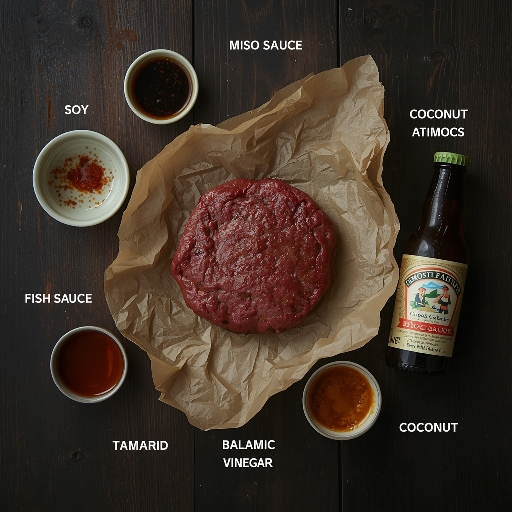
Worcestershire sauce is one of those ingredients that quietly does a lot of work. In burgers specifically, it’s not there for its own distinct flavor — it’s there to make the beef taste more like itself. That deep, slightly funky, savory boost it provides is what food people call umami. And when you don’t have it, or can’t use it, you need something that delivers a similar effect.
This article covers every practical substitute for Worcestershire sauce in burgers, explains what each one actually does to the flavor, and gives you the ratios you need to use them correctly. No filler, no guesswork.
What Worcestershire Sauce Actually Does in a Burger
It’s worth taking thirty seconds on this before jumping to substitutes.
Worcestershire sauce is a fermented condiment — typically made from vinegar, molasses, anchovies, tamarind, onion, garlic, and a range of spices. That combination produces a liquid that’s simultaneously savory, sweet, slightly tangy, and deeply complex. When mixed into ground beef before cooking, it does three things:
Enhances the meat’s natural flavor. The fermented fish (anchovy) content provides glutamates — amino acids that amplify savory taste. It makes the beef taste beefier without tasting like anything specific.
Adds moisture. Ground beef can dry out during cooking, especially at high heat. A tablespoon or two of Worcestershire adds liquid that helps the interior stay tender.
Contributes a subtle sweetness and tang. The molasses and vinegar balance each other and round out the overall flavor, preventing the burger from tasting flat.
Any good substitute needs to address at least one of these — ideally more than one.
The Best Substitutes for Worcestershire Sauce in Burgers
1. Soy Sauce
Best for: Nearly any burger recipe, fast substitution, consistent results
Soy sauce is probably the most reliable single-ingredient substitute. It’s fermented, loaded with glutamates, and salty in a way that deepens savory flavor rather than just making things taste salty. It lacks the sweetness and tang of Worcestershire, but the umami delivery is genuinely comparable.
Use about half the amount — if your recipe calls for two tablespoons of Worcestershire, use one tablespoon of soy sauce. Worcestershire is more dilute; soy sauce is more concentrated and saltier, so a 1:1 swap will overpower the meat.
If you want to get closer to the full flavor profile, mix one tablespoon of soy sauce with half a teaspoon of apple cider vinegar and a small pinch of brown sugar. That combination covers the tang and sweetness Worcestershire provides.
2. Soy Sauce + Apple Cider Vinegar + Brown Sugar
Best for: Closest overall match to Worcestershire, slightly more effort
This combination is basically a quick DIY Worcestershire — it won’t be identical, but in a burger it comes close enough that most people won’t notice a difference.
Mix together:
- 1 tablespoon soy sauce
- ½ teaspoon apple cider vinegar
- A small pinch of brown sugar (about ⅛ teaspoon)
Use this blend as a 1:1 replacement for Worcestershire sauce. The soy covers the umami, the vinegar adds acidity, and the sugar rounds it out. This is the go-to when you want the substitute to do the same complete job as the original.
3. Soy Sauce + Ketchup
Best for: Burgers that already have ketchup in the mix, simpler approach
Ketchup is made from tomatoes, vinegar, sugar, and spices — it’s essentially a concentrated tomato sauce with built-in acidity and sweetness. Combined with soy sauce, it hits most of what Worcestershire does.
Mix equal parts soy sauce and ketchup, then use the blend in a 1:1 ratio with Worcestershire. Since ketchup is already a burger flavor, this substitution feels especially natural. The tomato doesn’t stand out — it just adds depth.
This works particularly well in smash burgers and diner-style patties, where the flavor profile is already a bit more assertive.
4. Fish Sauce
Best for: Maximum umami, bold flavor, Southeast Asian-influenced burgers
Fish sauce is intensely fermented — much more so than Worcestershire. It’s made from salt-cured fish and delivers an extraordinary amount of glutamates in a small volume. A little goes a long way.
Use just half a teaspoon of fish sauce in place of a full tablespoon of Worcestershire. Mix it into the ground beef thoroughly; when cooked, the sharp fishy smell disappears almost completely, leaving behind pure savory depth.
If you’ve never added fish sauce to a burger, the first result will likely surprise you. The beef just tastes more intensely like beef. It’s one of those substitutions that many people end up preferring to the original.
5. Tamarind Paste
Best for: Tangy flavor emphasis, bold and slightly exotic flavor profile
Tamarind is actually one of Worcestershire sauce’s key original ingredients — it contributes that distinctive sweet-sour note. If you have tamarind paste on hand (common in Indian, Thai, and Middle Eastern cooking), it can do part of Worcestershire’s job on its own.
Use about one teaspoon of tamarind paste per tablespoon of Worcestershire. It’s more tart than Worcestershire, so balance it with a small amount of soy sauce for the savory component and a touch of sugar or honey to soften the acidity.
Tamarind-forward burgers have a unique flavor — slightly fruity, noticeably tangy. It works beautifully with beef that has a higher fat content (80/20 ground beef), where the richness can absorb the acid without the burger tasting sharp.
6. Balsamic Vinegar
Best for: Mild substitution, slightly sweet and tangy finish
Balsamic vinegar is aged, sweet, and complex — it doesn’t have the fermented depth of Worcestershire, but it contributes acidity and a molasses-like richness that partially mimics what Worcestershire brings.
Use about one teaspoon of balsamic vinegar per tablespoon of Worcestershire, and pair it with half a teaspoon of soy sauce for the savory component. On its own, balsamic lacks the umami — but combined with soy, it comes together as a reasonable substitute.
It works particularly well in burgers that include caramelized onions or mushrooms, where the sweetness of the balsamic fits naturally into the broader flavor story.
7. Miso Paste
Best for: Umami depth without any fish, vegan-friendly burgers
Miso is fermented soybean paste — dense with savory flavor and protein-based glutamates. It’s one of the best plant-based sources of the same deep umami that Worcestershire provides through its anchovy content.
Use half a teaspoon of white or yellow miso per tablespoon of Worcestershire. White miso is milder; red miso is more intense. Either works, but white miso is the safer starting point if you haven’t used it in meat before.
Dissolve the miso in a small amount of warm water before mixing it into the beef — this helps it distribute evenly rather than sitting in clumps. The flavor impact is significant. Miso burgers have a slightly nutty, deeply savory quality that’s genuinely excellent.
8. Steak Sauce (A1 or Similar)
Best for: Flavor-forward substitution, pantry convenience
Steak sauce is designed specifically to complement beef — it’s tangy, sweet, slightly spiced, and savory. In terms of flavor profile, it’s actually quite close to Worcestershire sauce, though thicker and more assertive.
Use it in a 1:1 ratio, but taste the burger mixture before cooking and adjust. Steak sauce is more forward-tasting than Worcestershire — it makes itself known, which isn’t necessarily a problem, just something to be aware of.
This is the most convenient substitution when you’re cooking for people who aren’t looking for subtlety, and it pairs well with bold toppings like sharp cheddar, pickled jalapeños, or crispy bacon.
9. Coconut Aminos
Best for: Soy-free diets, slightly sweeter flavor, gluten-free cooking
Coconut aminos is made from fermented coconut sap. It looks and behaves like a mild soy sauce — similar color, similar consistency, used in similar quantities — but it’s naturally sweeter and lower in sodium.
Use it in a 1:1 ratio with Worcestershire. It handles the savory and slightly sweet components well, though it lacks the tang. Adding a few drops of apple cider vinegar corrects that.
For people avoiding soy and gluten, coconut aminos is often the best-available substitute. It’s increasingly common in mainstream grocery stores, which makes it a practical option rather than a specialty-store purchase.
10. Liquid Smoke + Soy Sauce
Best for: Smoky burgers, charcoal grill flavor indoors
This combination doesn’t replicate Worcestershire exactly, but it produces a burger with compelling depth — savory from the soy, with a smoky backbone that works well with grilled beef.
Mix one tablespoon of soy sauce with two or three drops of liquid smoke. Use this in place of one tablespoon of Worcestershire. Start conservatively with the liquid smoke — it’s powerful, and too much turns the burger acrid rather than smoky.
This substitute is especially good for burgers cooked on a stovetop cast-iron pan, where you don’t get the outdoor grill flavor naturally.
Substitutes That Don’t Work Well (And Why)
A few options come up in internet discussions but genuinely underperform:
Plain white vinegar: Too sharp and one-dimensional. It adds acid without any complexity, and the harshness doesn’t cook off the way balanced vinegar (like apple cider or balsamic) does.
Teriyaki sauce: Too sweet. Teriyaki is heavily sweetened and has a distinctive flavor that competes with the beef rather than enhancing it. Fine as a topping; not ideal as an internal seasoning.
Hot sauce: Adds heat but contributes almost nothing in terms of umami or depth. It’s not a substitute — it’s a completely different ingredient with a different purpose.
How Much Worcestershire Sauce Goes in a Burger?
Most recipes call for one to two tablespoons per pound of ground beef. At that quantity, Worcestershire is functioning as a background enhancer — you shouldn’t be able to identify it in the finished burger; you should just notice that the burger tastes particularly good.
If you’re using a substitute, apply it with the same logic. Start with slightly less than the recipe calls for, taste the raw mixture (if safe to do so with the meat you’re using), and adjust. The goal is to add depth, not to introduce a new dominant flavor.
A Quick Reference Table
| Substitute | Use Ratio | Flavor Notes | Vegan | Best For |
|---|---|---|---|---|
| Soy sauce | ½:1 | Savory, salty | Yes* | Any burger |
| Soy + vinegar + sugar | 1:1 | Closest match | Yes* | Everyday cooking |
| Soy sauce + ketchup | 1:1 | Savory, tomato | Yes* | Diner-style burgers |
| Fish sauce | ¼:1 | Intense umami | No | Bold, savory patties |
| Tamarind paste | ⅓:1 | Tangy, fruity | Yes | Fat-rich beef blends |
| Balsamic vinegar | ⅓:1 | Sweet, acidic | Yes | Gourmet burgers |
| Miso paste | ⅓:1 | Nutty, deep umami | Yes | Vegan-friendly |
| Steak sauce | 1:1 | Bold, tangy | Yes | Assertive flavors |
| Coconut aminos | 1:1 | Mild, slightly sweet | Yes | Soy-free diets |
| Liquid smoke + soy | 1:1 | Smoky, savory | Yes* | Indoor/stovetop cooking |
Check labels for vegan certification — some soy sauces use animal-derived processing aids.
Tips for Mixing Substitutes Into Ground Beef
The technique matters almost as much as the ingredient. A few things worth doing consistently:
Add before forming patties. Mix the substitute into the ground beef before shaping — this distributes the flavor evenly throughout the meat rather than leaving it pooled in one spot.
Don’t overwork the meat. Mixing ground beef too aggressively makes it dense and tough when cooked. Combine just until the substitute is evenly incorporated — usually thirty seconds by hand is enough.
Let the patties rest briefly. After mixing and forming, resting the patties in the refrigerator for fifteen to twenty minutes helps them hold together during cooking and allows the flavors to settle into the meat.
Account for salt. Soy sauce, fish sauce, miso, and coconut aminos all contribute sodium. If you’re using these substitutes, hold back on any additional salt in the recipe and taste-adjust after cooking one small test patty first.
Final Thoughts
Worcestershire sauce earns its place in a burger through what it does invisibly — you taste the beef, not the sauce. The best substitutes work the same way. Fish sauce, miso, and the soy-vinegar-sugar blend all deliver that background savory depth without announcing themselves.
If you’re in a hurry and need something from the pantry right now, plain soy sauce gets you most of the way there. If you have a few extra minutes, the three-ingredient blend (soy, apple cider vinegar, brown sugar) is about as close as you’ll get without the real thing.
And if you want to try something genuinely new — a small amount of fish sauce in an 80/20 ground beef patty, cooked hard on a cast-iron skillet — it might become a permanent part of how you make burgers from now on.
See Also – Creamy Chili Crisp Pasta Recipe: The 15-Minute Weeknight Wonder That’s Taking Over American Kitchens